
FINANCIAL NEWS HIGHLIGHTS OF THE WEEK
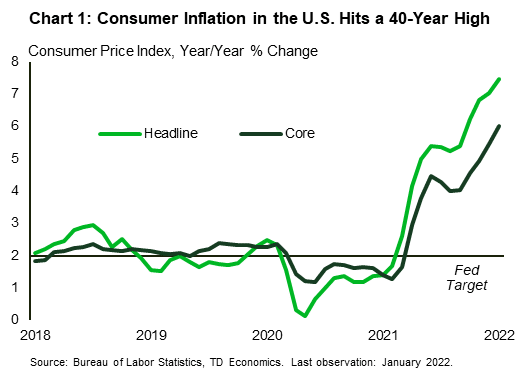
- U.S. prices continued to heat up in January as headline inflation accelerated to 7.5% year-on-year from 7.0% in December. Excluding food and energy, core prices also rose notably over the year to 6.0% with broad-based increases across index components.
- High inflation has firmed market expectations for aggressive tightening of monetary policy as the Fed is set to meet in mid-March. Financial markets responded with bonds yields generally heading higher, while equities retreated.
- For 2021, the U.S. posted a record trade deficit of $859 billion as imports surged.
U.S. -All Eyes on the Price
In financial news it was all about inflation this week, as the January CPI surpassed expectations and markets recalibrated their expectations for rate hikes. Headline inflation accelerated 0.5 percentage points to 7.5% year-on-year (y/y) in January, reaching the highest level in 40 years (Chart 1). Strong consumer demand coupled with pandemic-related supply constraints resulted in the strong price gains. Core prices were also up significantly relative to year ago levels at 6.0% (up from 5.5% in December). Price increases were relatively broad based across the index, with categories such as used motor vehicles (up 40.5%) and gasoline (up 40%) recording some of the largest gains versus a year ago.
Inflation is increasingly a top concern for small businesses. A survey of independent businesses showed that 22% of owners viewed inflation as their single most important problem in January. This matched the highest level previously recorded in 1981. High input prices coupled with rising labor costs are cutting into small firms’ profits. In response, 61% of firms reported having already raised prices. However, fewer firms (a net 47%) are planning to do so in the next three months, suggesting that firms may be nearing their limit for passing on cost increases to consumers.
Financial markets also responded to the inflation report as equities fell and yields on the 10-Year Treasury touched 2% for the first time since 2019. These movements occurred on the expectation that persistent high inflation will result in tighter Fed policy. The market-implied probability of at least a 50-basis point rate hike at the Fed’s March meeting shifted to over 50% after the report, from 24% the day before, suggesting expectations of more aggressive tightening.
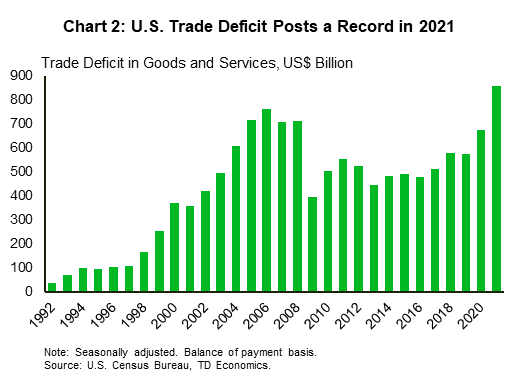
In other data, the U.S. trade deficit widened from $79.3 billion in November to $80.7 billion in December. The nation hit a record trade deficit of $859.1 billion for the full calendar year – a 27% increase over 2020 and blowing past the previous record of $763.5 billion in 2006 (Chart 2) in further financial news. For the year, imports were up 20.5% while exports grew by 18.5%. The notable rise in the trade deficit, highlights the strength of the U.S. economy as it rebounded from the pandemic. Consumers, supported by generous fiscal policy, shifted their spending patterns more towards goods over services during the pandemic, and consumer goods are heavily imported.
As the pandemic enters its third year, governments and citizens are more and more learning to just live with it. Many states, including California, Oregon, New Jersey, Connecticut, Delaware, New York, Illinois, Massachusetts and Rhode Island, have announced that rules requiring masks and/or proof of vaccinations will end by March. Local governments and school boards, however, have the discretion to maintain their own requirements.
These announcements are a step towards returning to normal, even as recently introduced cross-border vaccine mandates for truck drivers have sparked protests resulting in blockage of the busiest land border crossing between the U.S. and Canada. The slowdown at the Ambassador bridge crossing caused several car manufacturers to halt or slow production due to delays in delivery schedules. As the border re-opens and normal flow of traffic resumes, these disruptions are expected to dissipate.
Shernette McLeod, Economist | 416-415-0413
This Financial News report is provided by TD Economics. It is for informational and educational purposes only as of the date of writing, and may not be appropriate for other purposes. The views and opinions expressed may change at any time based on market or other conditions and may not come to pass. This material is not intended to be relied upon as investment advice or recommendations, does not constitute a solicitation to buy or sell securities and should not be considered specific legal, investment or tax advice. The report does not provide material information about the business and affairs of TD Bank Group and the members of TD Economics are not spokespersons for TD Bank Group with respect to its business and affairs. The information contained in this report has been drawn from sources believed to be reliable, but is not guaranteed to be accurate or complete. This report contains economic analysis and views, including about future economic and financial markets performance. These are based on certain assumptions and other factors, and are subject to inherent risks and uncertainties. The actual outcome may be materially different. The Toronto-Dominion Bank and its affiliates and related entities that comprise the TD Bank Group are not liable for any errors or omissions in the information, analysis or views contained in this report, or for any loss or damage suffered.