
Financial News Highlights
- Nonfarm payroll gains came in lower than expected in July, with the unemployment rate heading higher in financial news. The numbers add to other data suggesting that the U.S. labor market is losing steam.
- While the Federal Reserve held rates steady at their July meeting as widely expected, Chair Powell gave the strongest indication yet that a September rate cut is on the table.
- The manufacturing sector continued to struggle, as the ISM manufacturing index remained in contraction territory.
It’s A Different World
 The main highlights of the week were developments in the labor market and a mid-week update from the Federal Reserve. Several reports showed that conditions in the labor market were cooling, while the Fed largely lived up to expectations by holding rates steady. Their signals about a possible cut at the September meeting were generally of more interest to markets. In response to the September signal, stock markets rallied, and bond yields pulled back. This morning’s jobs number was even more of a market mover, with 10-year yields down 13 basis points relative to yesterday’s close.
What a difference a year makes. The U.S. economy today, with annualized growth slowing from about 4% towards a more trend-like 2%, inflation down and unemployment ticking up, looks starkly unlike it did a year ago according to Fed Chair Powell. After issuing a statement keeping the policy rate unchanged, at his press conference, Powell noted that last year, it was a completely different economy with higher inflation and a robust job market in financial news. Now, he notes, on the employment front, indicators show the job market has gradually normalized from “overheated” conditions and the Fed is able to weigh prices and the labor market more equally as inflation has cooled.
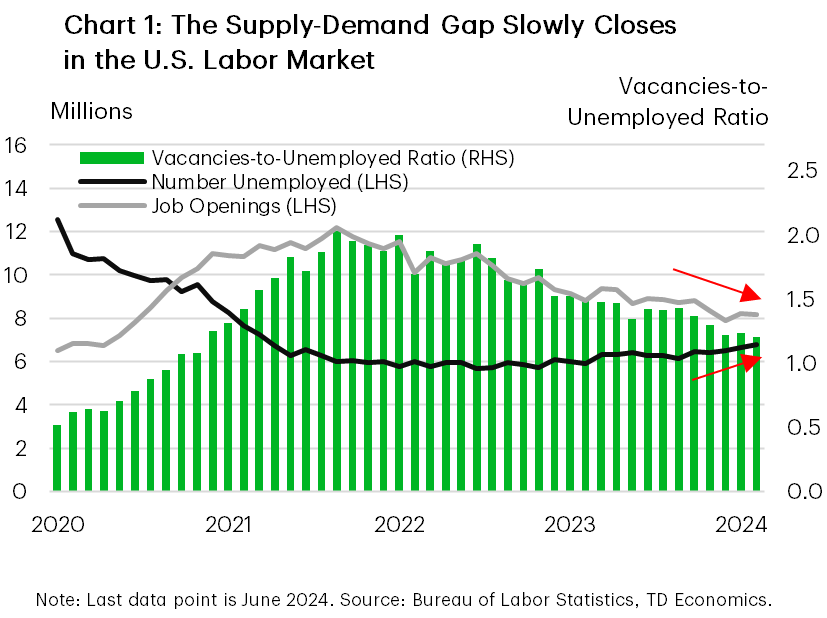
Reports out this week supported his statements on the job market. First up, the more backward-looking JOLTS data showed that the number of job openings in June inched down relative to May. While there are still plenty of jobs available relative to the more than 6.8 million unemployed job seekers in June — the gap has narrowed with the vacancies-to-unemployed ratio falling relative to its value in May (Chart 1). Other elements of the report also supported a softening labor market narrative – the hires rate ticked down and the quits rate was unchanged from May’s downwardly revised 2.1% (which is below where it was immediately prior to the pandemic). Additionally, the Employment Cost Index (ECI) report, which the Fed watches closely for wage trends, slowed at a faster-than-expected pace in Q2.
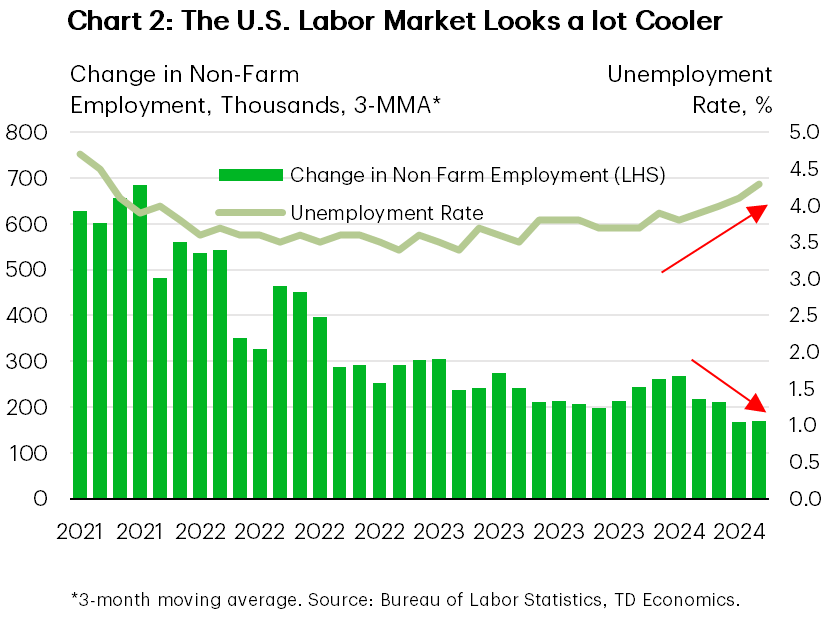 The signal from the more recent July payrolls report was generally in line with the JOLTS and ECI data. The economy added 114k jobs in July, missing expectations (Chart 2). The unemployment rate rose for the fourth consecutive month and annual wage growth decelerated to the slowest pace in over three years. Together, the three employment reports suggest that demand for workers continued to slow and add further evidence that the labor market is cooling.
On the production side, the ISM Manufacturing Index declined again in June. The series fell 1.7 points to 46.8, marking its fourth consecutive month in contraction territory after a short-lived reprieve in March. Demand continued to slow and output conditions worsened. Persistent contraction in the manufacturing sector alongside slowing consumer demand, present downside risks to US growth, which has already come off the above trend pace of last year.
As Chair Powell hinted at, the U.S. economy is in a different world now. As both sides of the Fed’s dual mandate come into sharper focus, a September cut is almost a guarantee and the chance for three rate cuts this year has certainly risen.
Shernette McLeod, Economist | 416-415-0413
This Financial News report is provided by TD Economics. It is for informational and educational purposes only as of the date of writing and may not be appropriate for other purposes. The views and opinions expressed may change at any time based on market or other conditions and may not come to pass. This material is not intended to be relied upon as investment advice or recommendations, does not constitute a solicitation to buy or sell securities and should not be considered specific legal, investment or tax advice. The report does not provide material information about the business and affairs of TD Bank Group and the members of TD Economics are not spokespersons for TD Bank Group with respect to its business and affairs. The information contained in this financial news report has been drawn from sources believed to be reliable but is not guaranteed to be accurate or complete. This report contains economic analysis and views, including about future economic and financial markets performance. These are based on certain assumptions and other factors and are subject to inherent risks and uncertainties. The actual outcome may be materially different. The Toronto-Dominion Bank and its affiliates and related entities that comprise the TD Bank Group are not liable for any errors or omissions in the information, analysis or views contained in this report, or for any loss or damage suffered. Do you have any questions about your finances? As financial advisors in Cornelius NC, Naples FL, and Moultonborough NH we are happy to help.
To see more news reports, click here.