
Financial News Highlights
- Longer-term Treasury yields continued to climb this week, despite the Treasury Department’s announcement to increase longer-duration debt buybacks.
- Elevated interest rates continue to weigh on housing activity, with housing starts plummeting 12.4% m/m to 1.2 million units in July.
- Minutes from the July 28-29 FOMC meeting showed policymakers’ concerns about inflation have deepened, with “several” participants ready to raise interest rates.
Long Yields, Short Relief
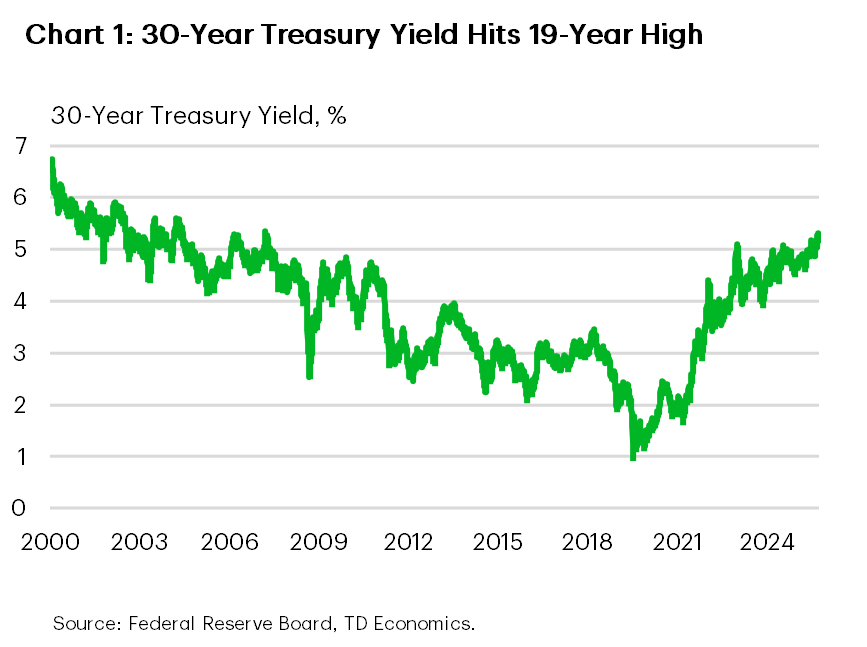
It was a quiet week on the economic data calendar, but a very active one in financial markets. Longer-term Treasury yields continued their relentless climb, with the 30-year yield briefly touching a 19-year high on Monday (Chart 1). Some relief came Wednesday, when the Treasury Department announced it would temporarily increase longer-duration debt buybacks to improve market liquidity. However, the move does nothing to change the broader fiscal backdrop, and at best only modestly alters the composition of debt holdings. With total U.S. government debt topping $40 trillion this week, bond markets quickly refocused on the troubling fiscal trajectory, leading yields to retrace most of Wednesday’s decline. Equity markets also came under pressure this week, despite multiple major retailers lifting earnings guidance. At the time of writing, the S&P500 is down 1.5%, while the NASDAQ is lower by 2.4%.
As we noted in our Quarterly Q&A, most of the recent increase in longer-term yields reflects two forces: shifting expectations for Fed policy and a higher term premium. While the precise drivers are difficult to isolate, fiscal supply concerns appear to be a major contributor to the rise in the term premium. With the U.S. expected to run annual deficits of +6% of GDP for the foreseeable future, the Treasury Department will need to issue a growing volume of securities. As issuance rises, investors are left to absorb more duration risk, which typically requires a higher term premium. Viewed through that lens, the solution will not come from adjusting the maturity mix of Treasury issuance, but rather from reducing the overall debt burden through fiscal consolidation.
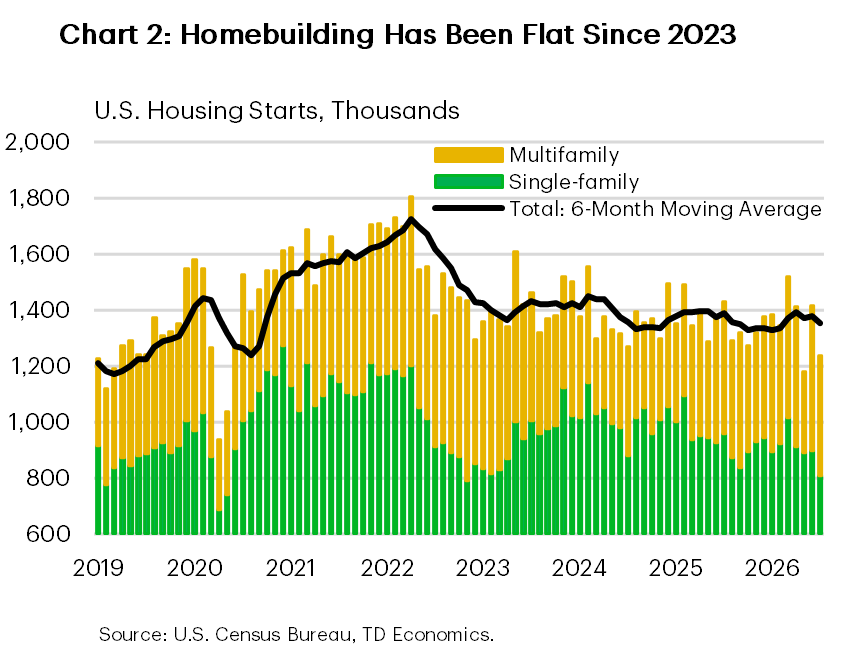
Turning to the real economy, few sectors have felt the impact of higher rates more acutely than housing. Data released this week reinforced that point, with housing starts falling 12.4% m/m to 1.2 million units—their second-lowest level outside the pandemic since March 2019. The deterioration was broad based, with declines across both single- and multifamily segments. Looking through the month-to-month volatility, homebuilding activity has effectively moved sideways since 2023 (Chart 2).
At this point, relief from lower policy rates looks unlikely. Minutes from the last FOMC meeting underscored policymakers’ growing concern over persistently elevated inflation. The minutes noted that “many participants assessed that policy tightening would likely be necessary if inflation did not decline,” while “some” viewed the recent tightening in financial conditions as insufficient to restore price stability. Admittedly, CPI data released after the July 28–29 FOMC meeting showed some further cooling in price pressures. But that may already feel somewhat backward-looking amid renewed tensions in the Middle East. WTI prices traded 5% higher this week and are now sitting at a four-week high of $86/bbl. More concerning is the growing tightness in refined product markets, particularly diesel and jet fuel. While Chair Warsh may touch on these developments in next week’s Jackson Hole speech, the focus is likely to lean more toward the “big questions” facing monetary policy than a near-term policy discussion. Without additional guidance, markets’ risk being left underwhelmed, potentially adding further upward pressure on longer-term yields.
This Financial News report is provided by TD Economics. It is for informational and educational purposes only as of the date of writing and may not be appropriate for other purposes. The views and opinions expressed may change at any time based on market or other conditions and may not come to pass. This material is not intended to be relied upon as investment advice or recommendations, does not constitute a solicitation to buy or sell securities and should not be considered specific legal, investment or tax advice. The report does not provide material information about the business and affairs of TD Bank Group and the members of TD Economics are not spokespersons for TD Bank Group with respect to its business and affairs. The information contained in this financial news report has been drawn from sources believed to be reliable but is not guaranteed to be accurate or complete. This report contains economic analysis and views, including about future economic and financial markets performance. These are based on certain assumptions and other factors and are subject to inherent risks and uncertainties. The actual outcome may be materially different. The Toronto-Dominion Bank and its affiliates and related entities that comprise the TD Bank Group are not liable for any errors or omissions in the information, analysis or views contained in this report, or for any loss or damage suffered. Do you have any questions about your finances? As financial advisors in Cornelius NC, Naples FL, and Moultonborough NH we are happy to help.
To see more news reports, click here.