
Financial News Highlights
- Annual revisions strengthened the economy’s growth profile and softened its inflation history, with firmer private demand alongside cooler underlying core PCE momentum.
- The jobs report delivered a more benign signal than the headline payroll miss suggested: hiring slowed but remained close to the labor market’s breakeven pace, while unemployment edged higher as more workers entered the labor force.
- Improved inflation trends alongside softer hiring and wage growth reduce the urgency of an October hike.
Hot and Cold
Wall Street spent another week discovering that a resilient economy does not guarantee life is simple or easy. Treasury yields remained elevated as oil prices, inflation concerns and expectations for another Federal Reserve hike outweighed an otherwise encouraging run of economic data. The broad message was awkwardly balanced: the economy is growing more quickly than previously estimated, underlying inflation has cooled more than previously thought, and the next wave of cost pressures is already appearing. Higher long-term yields tightened financial conditions in real time and kept equities on the defensive.
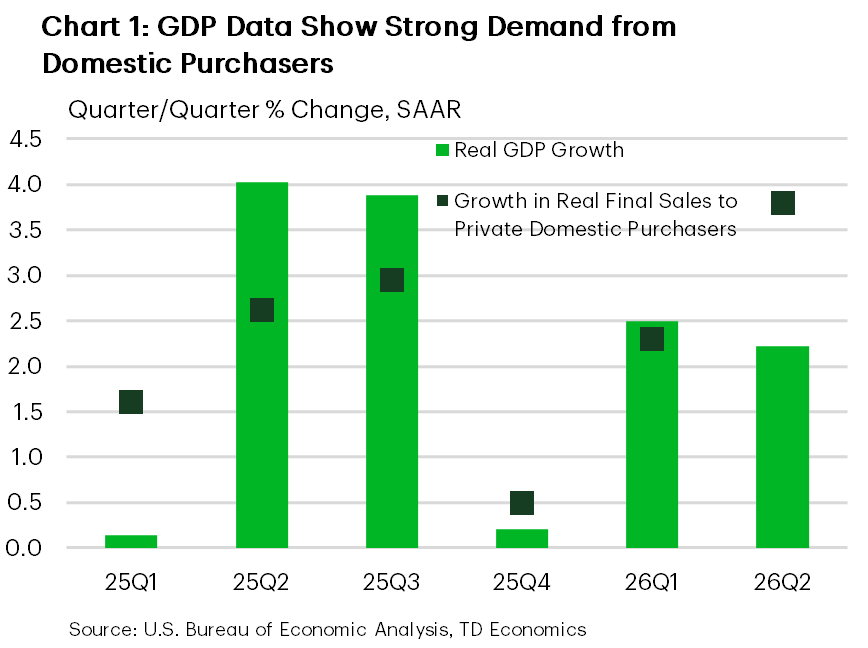
Wednesday’s annual update did more than lift the GDP numbers—it revealed that the economy had been running on a stronger engine than previously understood. The clearest signal came from real final sales to private domestic purchasers, which advanced at a robust 4.6% pace in Q2 (Chart 1). By stripping out inventories, trade and government spending, this measure showed that the resilience was rooted in household and business demand, not statistical noise or temporary supports. At the same time, the revisions lowered the recent inflation profile, giving the Fed a better combination of growth and price performance in hindsight. But hindsight is the key word: the revisions rewrote the economy’s past, but they do not guarantee its future. The revisions show that demand entered the current period from a position of strength but cannot speak to whether it can withstand elevated yields and cost pressures.
Other data this week, including spending and manufacturing reports, told a similar growth story, but with less comfortable inflation implications. Real consumer spending jumped 0.6% in August, its strongest monthly gain since March 2025, even as income lagged and the saving rate slipped to 4.1%. Consumers sounded glum in the confidence survey but kept spending, a familiar gap between what households say and what they do. Manufacturers were similarly busy. The ISM index held at a healthy 54.5 as new orders, backlogs and employment improved. But the catch was prices: the input-cost index surged as firms cited tariffs, metals and petroleum costs. The takeaway is that while demand is holding up, price pressures are building upstream.
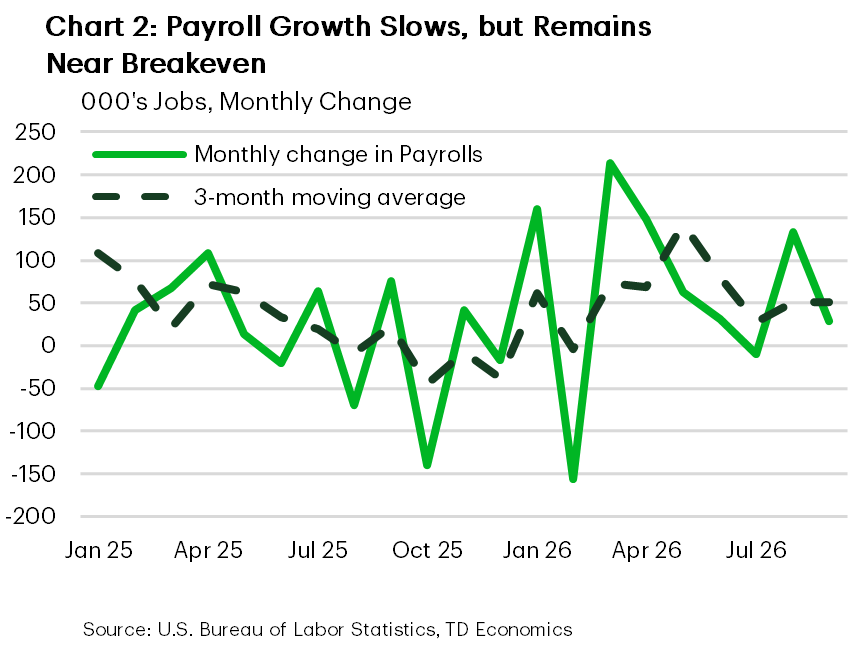
Payrolls rose by just 29,000 in September and prior months were revised lower, but the three-month average remained near the pace needed to keep the unemployment rate roughly stable (Chart 2). The slight rise in the unemployment rate was also less troubling than it appeared: it reflected a stronger expansion in the labor force than in household employment, with participation moving higher. Wage growth cooled further, easing concern that the labor market is adding to inflation pressure. Taken together, the report points to a labor market that is moderating without coming apart. Alongside softer PCE inflation and lower historical price estimates, that reduces the urgency for the Fed to hike again in October. The meeting remains live, with another CPI report still to come, but policymakers now have more room to wait.
Vikram Rai, Senior Economist | 416-923-1692
This Financial News report is provided by TD Economics. It is for informational and educational purposes only as of the date of writing and may not be appropriate for other purposes. The views and opinions expressed may change at any time based on market or other conditions and may not come to pass. This material is not intended to be relied upon as investment advice or recommendations, does not constitute a solicitation to buy or sell securities and should not be considered specific legal, investment or tax advice. The report does not provide material information about the business and affairs of TD Bank Group and the members of TD Economics are not spokespersons for TD Bank Group with respect to its business and affairs. The information contained in this financial news report has been drawn from sources believed to be reliable but is not guaranteed to be accurate or complete. This report contains economic analysis and views, including about future economic and financial markets performance. These are based on certain assumptions and other factors and are subject to inherent risks and uncertainties. The actual outcome may be materially different. The Toronto-Dominion Bank and its affiliates and related entities that comprise the TD Bank Group are not liable for any errors or omissions in the information, analysis or views contained in this report, or for any loss or damage suffered. Do you have any questions about your finances? As financial advisors in Cornelius NC, Naples FL, and Moultonborough NH we are happy to help.
To see more news reports, click here.