
Financial News Highlights
- The week’s data reminded markets that inflation is far away from the Fed’s target. Both headline and core CPI came in on par with expectations, but details suggest that disinflationary forces are softening.
- Retail sales rebounded from the year-end weakness. The biggest gains were picked up by auto dealers, but other categories were strong beyond expectations.
- More evidence of economic resilience means the Fed may need to fight harder to keep inflation under control. The probability of a 50-basis point hike in March rose from 9% to 21% on the week.
Higher for Longer
 “Resilient” is the epithet that describes this week’s economic data the best in financial news. Retail sales came in a full percentage point stronger than expected, while inflation figures point to a slower descent than expected. The reaction of the equity market was mixed: stock prices dipped after the initial releases but then bounced back, losing less than 1% on the week. Bond markets, on the other hand, continued to price in higher rates, with 2-year and 10-year yields rising by 18 and 22 basis points on the week (at the time of writing).
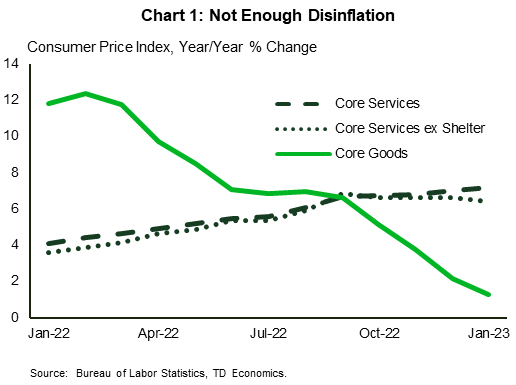
The source of this divergence is interpretation. The Consumer Prices Index (CPI) came in on par with expectations for both the headline and core (ex. food & energy) measures, which gained 0.4% and 0.5% on the month, respectively. Relative to last year, the pace of growth slowed to 6.4% for headline CPI and to 5.6% for core CPI in financial news. However, there were few convincing signs of weakness in core services inflation, even when excluding the shelter component – the most important metric for the monetary policy outlook, according to Chair Powell (Chart 1). This is at the time when the disinflationary contribution from core goods inflation appears to have taken a break, especially if the car prices turn higher next month (as signaled by the Manheim price index for used vehicles).
More inflationary pressure was also reported in the Producer Price Index (PPI), which surprised to the upside in January. The headline measure rose 0.7% month-on-month (m/m), while core inflation gained 0.5% m/m. A change in the PPI doesn’t always result in parallel changes in the CPI, but its volatile dynamic proves that the path to disinflation is not a straight line.
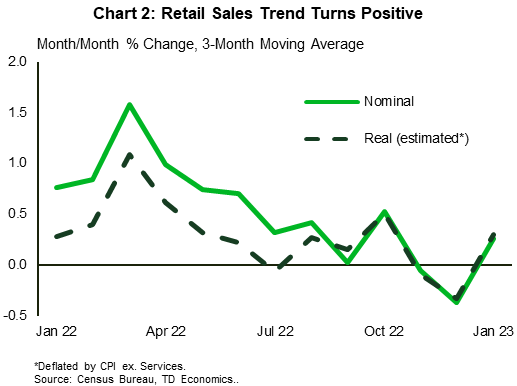 In the context this week’s retail sales report, however, persistent inflation seems less surprising. A warmer January helped heat up consumers’ aptitude to spend. The biggest gains were picked up by auto dealers, primed by the remaining pent-up demand and improved supply as production continues to recover. Predictably, nicer weather made dining out more pleasant, making restaurants the second largest contributor to growth last month. But other categories (department stores, e-commerce, and furniture & electronics stores to name a few) were also robust beyond expectations. This suggests that demand remains resilient: our estimate of real sales was up 2.8% on the month, turning the three-months trend positive (Chart 2).
What didn’t respond to warm weather is housing starts, which fell by 4.5% m/m in January, coming in below the consensus forecast. Both single- and multi-family segments were softer, but while the former remains below its pre-pandemic average, the latter remains 27% stronger relative to 2018-19. Still, housing construction is the only measure that held a course towards disinflation this week. The rest of the economic data makes a “compelling economic case” to bring rates higher and keep them there for longer. As a result, the probability of a 50-basis point hike in March rose from 9% to 21% on the week, while bets on fewer rate cuts by the end of the year jumped higher. We now expect the Fed will raise the policy rate to 5.25% and keep it there until the fourth quarter of 2023 (see D&S).
Maria Solovieva, CFA, Economist | 416-380-1195
This Financial News report is provided by TD Economics. It is for informational and educational purposes only as of the date of writing and may not be appropriate for other purposes. The views and opinions expressed may change at any time based on market or other conditions and may not come to pass. This material is not intended to be relied upon as investment advice or recommendations, does not constitute a solicitation to buy or sell securities and should not be considered specific legal, investment or tax advice. The report does not provide material information about the business and affairs of TD Bank Group and the members of TD Economics are not spokespersons for TD Bank Group with respect to its business and affairs. The information contained in this financial news report has been drawn from sources believed to be reliable but is not guaranteed to be accurate or complete. This report contains economic analysis and views, including about future economic and financial markets performance. These are based on certain assumptions and other factors and are subject to inherent risks and uncertainties. The actual outcome may be materially different. The Toronto-Dominion Bank and its affiliates and related entities that comprise the TD Bank Group are not liable for any errors or omissions in the information, analysis or views contained in this report, or for any loss or damage suffered.
To see more news reports, click here.