
FINANCIAL NEWS HIGHLIGHTS OF THE WEEK
- Early signs of the pandemic’s toll on economic activity were evident in softer-than-expected home sales and a deceleration in regional manufacturing surveys.
- The current soft patch will likely prove temporary, and the broader economic trend is still one of robust growth.
- With strong demand showing increasing resilience to new pandemic waves, the Fed will remain on course to raise the federal funds rate.
U.S. -Momentum Slows Amid Pandemic Wave
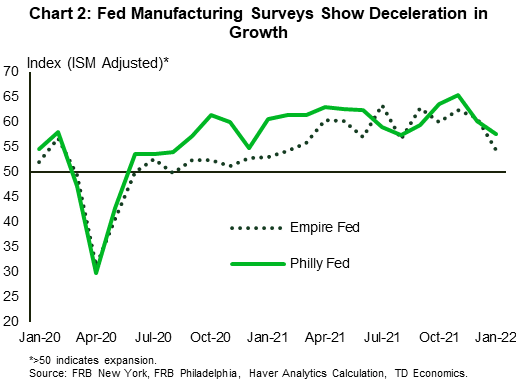
This week’s data releases showed some slowing in U.S. economic momentum through the winter months in financial news. In line with last week’s reported pullback in retail sales, existing home sales took a tumble in December. The soft patch looks to have continued at the start of the year, with both the Empire State and Philadelphia Fed manufacturing surveys weakening to multi-month lows in January.
Fortunately, it wasn’t all bad news as housing starts exceeded expectations, hitting their highest level in nine months in December. The virus-induced demand slowdown is likely to prove temporary, and the supply side of the economy is still playing catch up. The Federal Reserve is likely to signal as much at its meeting next week, setting the stage for policy rate liftoff at its following meeting in March (link).
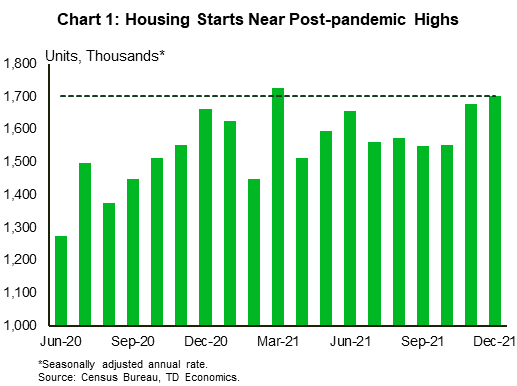
First up, the good news. Wednesday’s release of December’s housing starts data showed homebuilders are adding supply to a market in dire need of it (Chart 1). Starts rose to 1.7 million units (annualized) in December, a 1.7% increase over the prior month. The gain built on upward revisions of 49k units in the prior two months. The improvement was entirely in the multifamily segment, which posted a 51k unit increase (+10.6% m/m), while the single-family segment pulled back 27k units (-2.6% m/m). As starts perked up, so did permitting activity. Permits were up 9.1% for the month, rising to 1.9 million – the highest reading since July 2020. As with starts, this was mostly a multi-family story as permitting in the segment rose 21.9%, dwarfing the 2.0% lift in the single-family segment.
Homebuyers, on the other hand, showed some hesitancy in December. Existing home sales fell 4.6%, undershooting the market consensus for a 0.5% pull back. Surging Covid cases and a lack of inventory explain the setback. At the current pace of sales there exists only 1.8 months’ supply of homes – half the 3.9 months’ average in the three years before the pandemic.
This is an extraordinarily tight housing market, and with demand still strong it’s no surprise that the median transacted price again registered double-digit year-over-year gains – accelerating to 15.8% from 14% in November. The sharp rise in prices has worsened affordability in financial news. Higher interest rates will exacerbate this challenge and are likely to slow demand growth over the next year. The silver lining is that higher prices and higher carrying costs should lead to more supply in both the existing and new market, helping to rebalance the market.
Finally, softening economic conditions were reflected in the Empire State and Philadelphia Fed Manufacturing surveys in January. On an ISM adjusted basis, both pulled back for the month registering 54.4 and 57.6, respectively. While readings above 50 imply the expansion continued in January, the Empire state index is now at its lowest level since January of last year, while its counterpart out of Philadelphia is now at its lowest level since August.
That said, this week’s data reflect a temporary blip in the path of the recovery. The Fed will remain focused on the broader trends – strong growth and persistent shortages – as they start the rate hiking cycle in the coming months.
Andrew Hencic, Senior Economist
This Financial News report is provided by TD Economics. It is for informational and educational purposes only as of the date of writing, and may not be appropriate for other purposes. The views and opinions expressed may change at any time based on market or other conditions and may not come to pass. This material is not intended to be relied upon as investment advice or recommendations, does not constitute a solicitation to buy or sell securities and should not be considered specific legal, investment or tax advice. The report does not provide material information about the business and affairs of TD Bank Group and the members of TD Economics are not spokespersons for TD Bank Group with respect to its business and affairs. The information contained in this report has been drawn from sources believed to be reliable, but is not guaranteed to be accurate or complete. This report contains economic analysis and views, including about future economic and financial markets performance. These are based on certain assumptions and other factors, and are subject to inherent risks and uncertainties. The actual outcome may be materially different. The Toronto-Dominion Bank and its affiliates and related entities that comprise the TD Bank Group are not liable for any errors or omissions in the information, analysis or views contained in this report, or for any loss or damage suffered.