
Financial News Highlights
- Financial markets were volatile as technology stocks came under pressure amid renewed scrutiny of AI spending, while elevated oil prices added to inflation concerns.
- The Fed held rates unchanged for a fifth consecutive meeting. Growing markets’ concerns about the Fed’s ability to lower inflation pushed 30-year Treasury yields to a 19-year high.
- Second-quarter GDP growth moderated, but a softer headline print masked stronger domestic demand as consumer spending rebounded and business investment remained strong.
Markets Issue a Yellow Card to the Fed
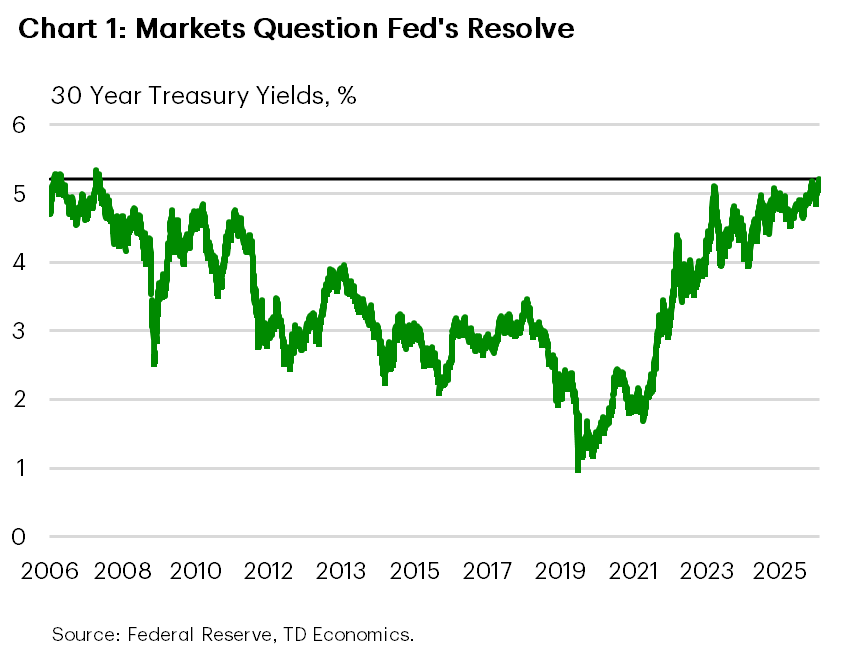
Financial markets had plenty to digest this week, with mega-cap tech earnings, the FOMC decision, and the second-quarter GDP. Equities swung sharply as investors weighed technology earnings against renewed scrutiny over AI-related capital spending and China’s progress in AI capabilities and semiconductor manufacturing. Still, stronger-than-expected results from several technology heavyweights helped revive the sentiment toward the end of the week. Oil prices also were in focus, with WTI crude easing relative to last week’s highs, but remained elevated at around US$85 per barrel Friday morning. Against that backdrop, investors have turned their attention to the Fed, where growing concern about inflation and rising doubts over the Committee’s willingness to do what is necessary to restore price stability pushed longer-term Treasury yields sharply higher.
The FOMC meeting was the week’s marquee event, though the main surprise was in the vote and not the policy announcement. Three officials dissented in favor of a 25-basis-point hike, highlighting growing concern within the Committee about inflation risks. The data support that concern. While inflation eased modestly in June, the improvement is unlikely to last if energy prices remain elevated. Core PCE inflation has remained above the Fed’s 2% target for more than five years, and the Fed is still searching for the back of the net. So even as Chair Warsh reiterated that the Committee would not “waver” in its commitment to restoring price stability, financial markets grew uneasy about the Fed’s willingness to raise rates to bring inflation back to target. 30-Year Treasury yields rose sharply following the meeting and remain near a 19-year high (Chart 1).
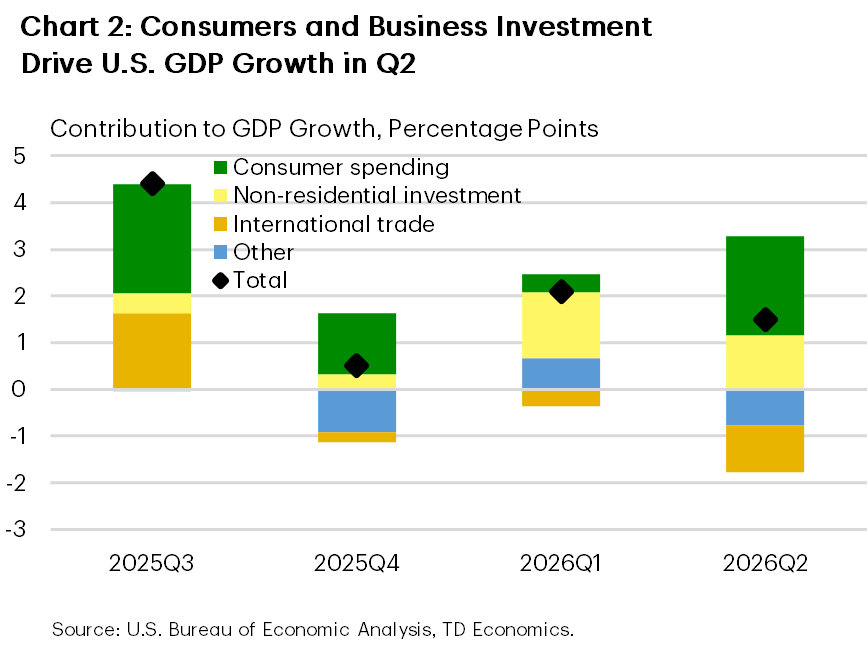
Despite the market jitters, the incoming data still point to an economy with solid underlying momentum. Real GDP growth slowed to a 1.5% annualized pace in the second quarter from 2.1% previously, but the softer headline largely reflected a surge in imports, with net trade subtracting roughly one percentage point from growth.
Under the hood, the economy’s engine was running considerably hotter than the headline GDP figure suggested, supported by a rebound in consumer spending and robust business investment (Chart 2). Consumer spending rebounded by a solid 3.2% annualized after a weather-affected first quarter. However, spending continued to outpace income, pushing the personal saving rate to its lowest level since mid-2022. With the boost from larger tax refunds fading, consumer resilience will increasingly depend on labor market strength and rising household wealth. Business investment also remained a bright spot. AI-related investment remained robust, but it was no longer the only game in town. Spending on industrial equipment surged 29% annualized in the second quarter, adding to evidence that the current capital spending cycle is becoming more broad-based.
Next week’s ISM surveys and the July employment report will shed further light on the balance of risks to prices and employment. For now, resilient domestic demand and persistent inflation pressures suggest the Fed’s inflation fight is entering overtime, with markets seeking reassurance that policymakers can credibly bring inflation back to target.
This Financial News report is provided by TD Economics. It is for informational and educational purposes only as of the date of writing and may not be appropriate for other purposes. The views and opinions expressed may change at any time based on market or other conditions and may not come to pass. This material is not intended to be relied upon as investment advice or recommendations, does not constitute a solicitation to buy or sell securities and should not be considered specific legal, investment or tax advice. The report does not provide material information about the business and affairs of TD Bank Group and the members of TD Economics are not spokespersons for TD Bank Group with respect to its business and affairs. The information contained in this financial news report has been drawn from sources believed to be reliable but is not guaranteed to be accurate or complete. This report contains economic analysis and views, including about future economic and financial markets performance. These are based on certain assumptions and other factors and are subject to inherent risks and uncertainties. The actual outcome may be materially different. The Toronto-Dominion Bank and its affiliates and related entities that comprise the TD Bank Group are not liable for any errors or omissions in the information, analysis or views contained in this report, or for any loss or damage suffered. Do you have any questions about your finances? As financial advisors in Cornelius NC, Naples FL, and Moultonborough NH we are happy to help.
To see more news reports, click here.