
Financial News Highlights
- The U.S. economy continued to add jobs in May, though at a slower pace than in the previous month. The unemployment rate held steady at 3.6% and the labor force participation rate edged up by 0.1 percentage point.
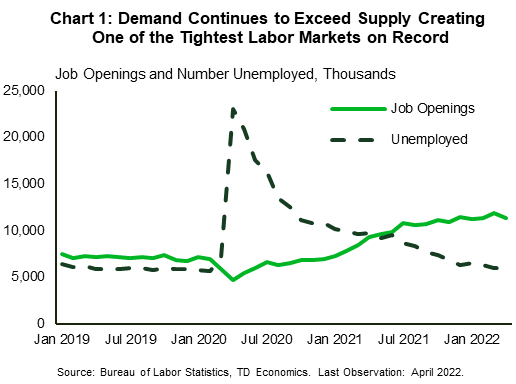
- Job openings remained elevated at 11.4 million, even while workers continued to quit their jobs. With job openings exceeding the number of unemployed workers, labor market conditions may remain tight for some time yet.
- Both manufacturing and services activity continued to expand in May, though services did so at a slower rate. Both sectors also felt the hiring pinch, as the availability of workers dwindled.
U.S. -Jobs Abound but Too Few Workers Around
This week marks the start of a new month and with it, the start of the Fed’s quantitative tightening program in financial news. As it tightens monetary policy to fight inflation, the Fed will allow up to $47.5 billion of its treasury and mortgage-backed securities holdings to mature this month without reinvesting the proceeds. The net effect should help to push rates higher and tighten financial conditions, helping ease price pressures.
The Fed’s Beige Book also reported that companies continued to struggle with rising prices and labor shortages during the spring, resulting in modest economic growth. The report notes however, that consumers are starting to push back on higher prices, thereby limiting companies’ ability to fully pass on cost increases. To deal with labor shortages some businesses implemented greater automation, offered more job flexibility, and/or increased wages.
Job opening data for April further reinforced the tight labor market narrative. There were 11.4 million job openings in April, a pullback from the 11.9 million record attained in the previous month, but still well above pre-pandemic figures. Churn in the market remained elevated with workers quitting their jobs 4.4 million times, little changed from the prior month. The number of job openings has exceeded the number of unemployed persons looking for work for much of the past year (Chart 1) as fewer persons are seeking employment relative to before the pandemic.
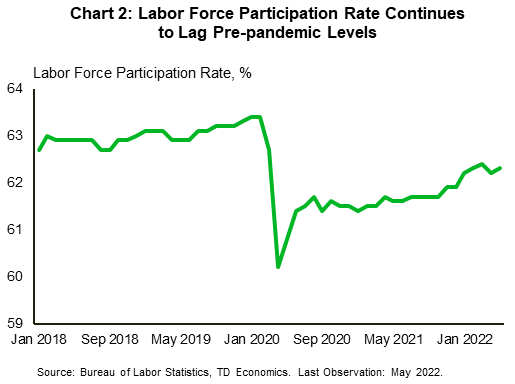
The trend is set to continue as the U.S. added 390k jobs in May, lower than the 436k in April but ahead of market expectations for 325k (see here). Job gains were notable in leisure and hospitality, professional and business services, and in transportation. Notably, employment in retail trade declined. The unemployment rate held steady at 3.6% – close to the 50-year low of 3.5%. While the labor-force participation rate continued to recover at 62.3%, it was still below the 63.4% attained prior to the pandemic, thereby contributing to the labor supply slump (Chart 2).
The ISM manufacturing survey showed that activity in the sector continued to accelerate in May despite supply-chain and pricing challenges (see here) in financial news. The index came in at 56.1, exceeding April’s 55.4 print. New orders, backlogs of orders and the production index all rose, reflecting manufacturers’ struggles to keep up with above-trend demand for goods.
Conversely, while still in growth territory, activity in the services sector decelerated in May to 55.9 from 57.1 (see here). Despite new orders being higher on the month, business activity pulled back 4.6 points to a two-year low of 54.5. Services activity is expected to pick-up speed as summer progresses, though rising prices present challenges.
Despite current strong economic conditions, consumer confidence took a hit for the second consecutive month as high inflation soured the outlook. The Conference Board consumer confidence index dipped to 106.4 in May, from 108.6 in April, with both the present situation and the expectations index declining. Rising inflation, and measures to counteract it, may be putting a damper on consumers as they brace for the possible fallout.
Shernette McLeod, Economist | 416-415-0413
This Financial News report is provided by TD Economics. It is for informational and educational purposes only as of the date of writing and may not be appropriate for other purposes. The views and opinions expressed may change at any time based on market or other conditions and may not come to pass. This material is not intended to be relied upon as investment advice or recommendations, does not constitute a solicitation to buy or sell securities and should not be considered specific legal, investment or tax advice. The report does not provide material information about the business and affairs of TD Bank Group and the members of TD Economics are not spokespersons for TD Bank Group with respect to its business and affairs. The information contained in this report has been drawn from sources believed to be reliable but is not guaranteed to be accurate or complete. This report contains economic analysis and views, including about future economic and financial markets performance. These are based on certain assumptions and other factors and are subject to inherent risks and uncertainties. The actual outcome may be materially different. The Toronto-Dominion Bank and its affiliates and related entities that comprise the TD Bank Group are not liable for any errors or omissions in the information, analysis or views contained in this report, or for any loss or damage suffered.
To see more news reports, click here.