
Financial News Highlights
- The tariff news felt like a tennis match this week in financial news. Tariff threats on the EU were paused. Then a court struck down the IEEPA tariffs, only to have an appeal court say they could remain in place.
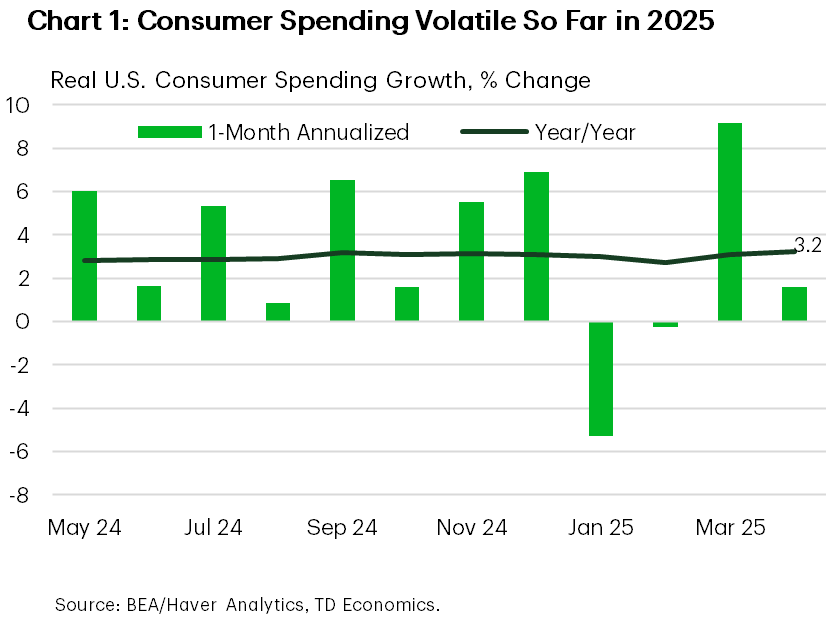
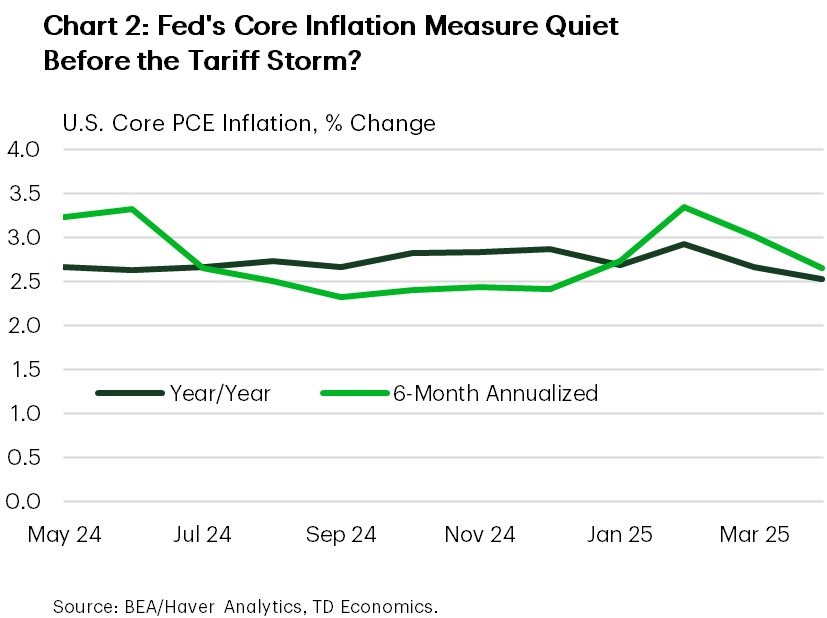
- The economic data showed that inflation pressures were steady through April, while consumer spending has been very volatile so far in 2025.
- President Trump also voiced his desire for rate cuts directly to the Fed Chair this week. Powell reinforced his message that the Fed will be guided by the data.
Tariff News Tennis Match Continues
 Equity markets looked to end the week in the black as the tariff news tennis match seemed to net out on the good news side. The week started with a pause on Trump’s 50% tariff threat against the European Union, then a court struck down some of the Trump administrations’ tariffs before the appellate court deemed they could remain in place for now.
A U.S. trade court invalidated the Trump administration’s use of the International Emergency Economic Powers Act (IEEPA) to levy tariffs. These tariffs include the Canada/Mexico/China “fentanyl” tariffs and the 10% “reciprocal” tariffs. The court ruling has no impact on sectoral tariffs, including those on steel & aluminum and autos. These court battles don’t make it any clearer what will happen with tariffs in the near-term. The administration has other tools they could use to implement tariffs, so this may just be a bump in the road.
The revisions to first quarter economic growth didn’t really change the narrative (see commentary). The slight contraction in the economy was due to a huge surge in imports, while the domestic economy was still running at a solid 2.5% pace. However, some of that growth was likely due to tariff front-running. These distortions make it harder to get a read on underlying momentum in the economy.
One potential warning sign in the first quarter data was a decline in corporate profits. The drop was seen in nonfinancial firms, which may be a signal that they are coming under pressure. However, April’s personal income data showed that income gains on the household side have been resilient. Incomes were boosted by the implementation of the Social Security Fairness Act, which provided a one-time lift. But even so, wages and salaries continue to grow at a healthy clip. Combined with softer spending growth, the personal savings rate ticked up to its highest level in a year, suggesting consumers have some gas in the tank.
 Consumers did take a bit of a breather in April after a solid increase in outlays in March (Chart 1). Consumer spending has been quite volatile so far in 2025, whipsawed by natural disasters and swings in durable goods purchases on things like autos as they try to front run tariffs. This makes it difficult to discern a trend in consumer spending. Even so, we expect that weaker sentiment and a softer labor market ahead will cool the pace of spending in the coming quarters.
The inflation news was steady-as-she goes in April (Chart 2). However, it is a bit early yet to see much inflation pressure from tariffs. We expect inflation will be lifted above 3% later this year as companies pass along higher tariffs to consumers.
President Trump met with Fed Chair Powell for the first time in his second term, reiterating his view that the Fed is making a mistake by not lowering interest rates. Powell stressed that policy decisions would be dependent on the economic data. The Fed minutes from their decision in early May suggested that they are in no hurry to cut rates as they wait for more clarity on the tariff front. Volatility is making it difficult to get clarity on the economic data these days. Add it all up, and the Fed’s wait and see approach is warranted for now.
This Financial News report is provided by TD Economics. It is for informational and educational purposes only as of the date of writing and may not be appropriate for other purposes. The views and opinions expressed may change at any time based on market or other conditions and may not come to pass. This material is not intended to be relied upon as investment advice or recommendations, does not constitute a solicitation to buy or sell securities and should not be considered specific legal, investment or tax advice. The report does not provide material information about the business and affairs of TD Bank Group and the members of TD Economics are not spokespersons for TD Bank Group with respect to its business and affairs. The information contained in this financial news report has been drawn from sources believed to be reliable but is not guaranteed to be accurate or complete. This report contains economic analysis and views, including about future economic and financial markets performance. These are based on certain assumptions and other factors and are subject to inherent risks and uncertainties. The actual outcome may be materially different. The Toronto-Dominion Bank and its affiliates and related entities that comprise the TD Bank Group are not liable for any errors or omissions in the information, analysis or views contained in this report, or for any loss or damage suffered. Do you have any questions about your finances? As financial advisors in Cornelius NC, Naples FL, and Moultonborough NH we are happy to help.
To see more news reports, click here.