
Financial News Highlights
- In financial news the U.S. announced a trade deal with the U.K. to reduce several product-specific tariffs, although the 10% reciprocal tariff faced by the U.K. remained in place.
- Formal trade negotiations with China are expected to begin this weekend in Switzerland, as the third largest trading partner of the U.S. remains subject to 145% tariffs.
- The Federal Reserve left interest rates unchanged for the third time this year. Chair Powell noted that it would take time to discern the effects of tariffs on the economy.
The First of Many?
 The first full week of May looked like it may provide a modest respite for financial markets, as economic data releases were limited and the Federal Reserve’s decision on Wednesday was short on surprises. However, this proved to be short-lived as the White House announced a preliminary trade deal with the U.K. on Thursday. The S&P 500 ended the week roughly unchanged at time of writing, while the 10-year U.S. Treasury yield rose 4 basis points to 4.36%.
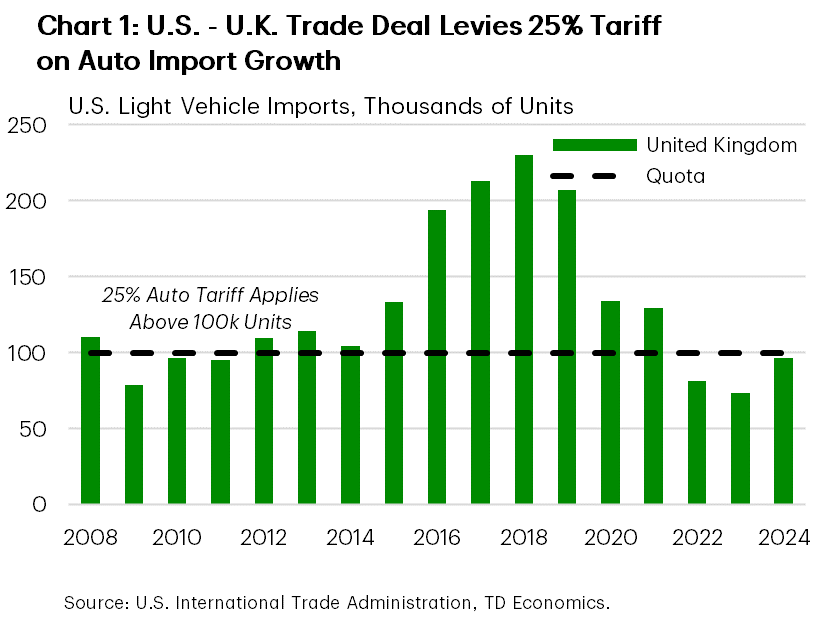
The preliminary trade deal between the U.S. and U.K. (see here), included a full exemption on Section 232 steel and aluminum tariffs for the U.K., in addition to an annual exemption on automotive tariffs for the first 100k units imported (Chart 1). The market reaction to the agreement was relatively tame, as the 10% baseline reciprocal tariff remained in effect. The President noted that this would likely be the global floor for reciprocal tariffs, and that other nations may see levels above this even after negotiations have concluded. It is unclear whether this would be acceptable to other nations. If they take a harder stance during upcoming negotiations, it could delay a broader resolution to the current state of elevated trade tensions.
The EU also outlined a list of goods this week that would be subject to retaliatory tariffs in financial news. The list covers nearly a third of U.S. exports to the region. These tariffs would be levied if negotiations do not result in “a mutually beneficial outcome and the removal of U.S. tariffs”. Chinese officials also called on the U.S. to “be prepared to correct its erroneous actions and cancel its unilateral tariff increases”, ahead of the planned start of formal negotiations with the U.S. this weekend. Early on Friday the President floated the idea of lowering the tariff rate on China to 80%, but no final decision has been made. With less than two months until the 90-day suspension of U.S. reciprocal tariffs expires and dozens of deals yet to be made, time will remain of the essence on the trade front in the weeks ahead.
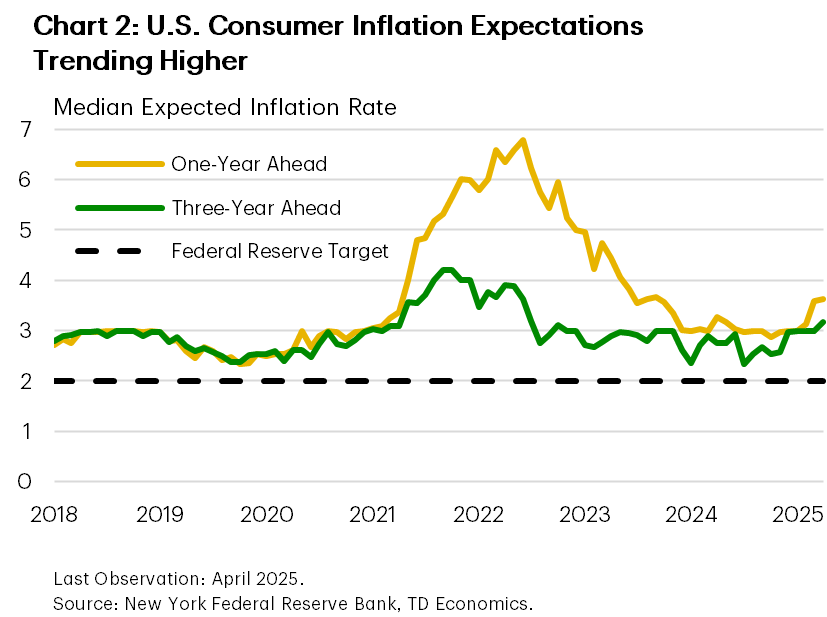 The Federal Reserve pointed to the clouds hanging over the economic outlook in its rate decision on Wednesday. It was the third meeting in a row where the FOMC left the federal funds rate unchanged. During his press conference, Chair Powell highlighted the likelihood that current trade policies would push the unemployment rate and inflation to deviate from the Fed’s dual mandate. However, he also noted that uncertainty remains elevated with respect to the magnitude of the deviation, meriting caution in monetary policy decisions at this time. With survey-based measures of inflation expectations remaining elevated in April (Chart 2), the Fed’s caution would appear prudent at this time.
Next week, we’ll receive a first look at inflation data for April with the CPI data release, in addition to April retail sales. Although neither is expected to be materially influenced by tariff impacts yet, they will provide a pulse check on consumer and price trends. Also on the docket for next week is the reconciliation bill markup for the House Ways & Means Committee, which could provide insight on the specific tax cut provisions being considered by Congress. Although fiscal policy may not fully offset the influence of tariffs on the economy this year, it could help to prevent a more material slowdown.
This Financial News report is provided by TD Economics. It is for informational and educational purposes only as of the date of writing and may not be appropriate for other purposes. The views and opinions expressed may change at any time based on market or other conditions and may not come to pass. This material is not intended to be relied upon as investment advice or recommendations, does not constitute a solicitation to buy or sell securities and should not be considered specific legal, investment or tax advice. The report does not provide material information about the business and affairs of TD Bank Group and the members of TD Economics are not spokespersons for TD Bank Group with respect to its business and affairs. The information contained in this financial news report has been drawn from sources believed to be reliable but is not guaranteed to be accurate or complete. This report contains economic analysis and views, including about future economic and financial markets performance. These are based on certain assumptions and other factors and are subject to inherent risks and uncertainties. The actual outcome may be materially different. The Toronto-Dominion Bank and its affiliates and related entities that comprise the TD Bank Group are not liable for any errors or omissions in the information, analysis or views contained in this report, or for any loss or damage suffered. Do you have any questions about your finances? As financial advisors in Cornelius NC, Naples FL, and Moultonborough NH we are happy to help.
To see more news reports, click here.