
Financial News Highlights
- Results from the midterm elections showed the Democrats maintained control of the Senate but lost their majority in the House of Representatives.
- U.S. housing data continue to slide in October, with housing starts down 4.1% m/m to 1.4 million units, while existing home sales fell 5.9% m/m to 4.3 million.
- Retail sales surprised to the upside in October, rising by 1.3% m/m. Gains were relatively broad based and suggest the U.S. consumer remains on a firm footing. Real consumer spending is set to accelerate to 3% in Q4.
Consumer Resilience on a Timer
 After a week of ballot counting, results from the midterm elections showed that the Democrats maintained control of the Senate but lost their majority in the House of Representatives. With the Republican’s now having narrow control of the House, we have returned to a divided Congress, limiting prospects of new legislation over the next two years.
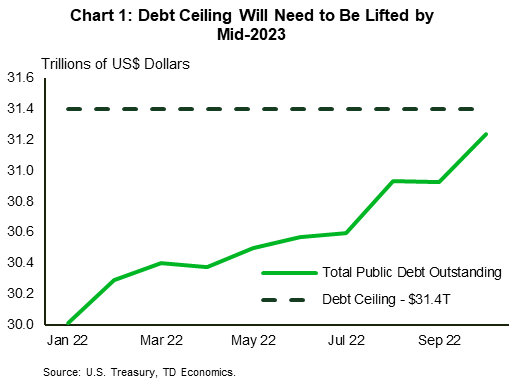
A partisan Congress raises the odds of another government shutdown or debt-ceiling showdown at some point next year (Chart 1) in financial news. We could get a firsthand glimpse of what’s to come as early as next month when the current ‘continuing resolution’ funding government spending expires on December 16th. At a minimum, Congress will need to negotiate another short-term patch to keep the federal government open. The other challenge that will come up in the coming months is the need to raise the debt-ceiling. Fortunately, the U.S. Treasury is estimated to have enough wiggle room in its existing cash holdings to fund the government through at least mid-2023.
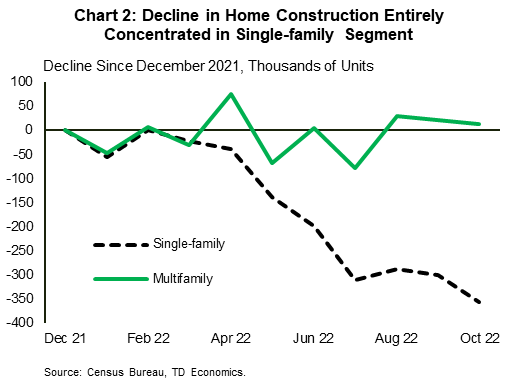
Looking to this week’s economic data, the impact of higher interest rates continued to tighten its grip on the housing sector. New home construction fell 4.2% m/m to 1.4 million units in October and is now down 19.4% since the beginning of the year. While the pullback continues to be concentrated across the single-family segment, the recent plateauing in multifamily permits suggests it too has peaked (Chart 2). Things look even more dire in the resale market. Mortgage rates reached 7.2% in October, and sales fell by another 5.9% m/m to 4.3 million and are now (outside of the pandemic lockdown period) at the lowest level since 2011. Inventory has remained tight so far and so the impact to prices has been small, with the median home price down just 3.5% from its peak. Because most homeowners hold mortgages originated at rates lower than today’s prevailing rate, listings are unlikely to spike like during the last housing crisis. As a result, the market will remain undersupplied for some time, limiting the downside pressure on prices.
 In stark contrast to the housing sector, the U.S. consumer continued to show considerable staying power in October. Retail sales came in much better than expected, rising by 1.3% m/m. Indeed, some of the strength in October was already telegraphed earlier in the month when new vehicle sales jumped 10% m/m to 14.9 million units in financial news. However, even after stripping out autos, sales at gasoline stations, and building materials, the ‘control’ measure still rose by a healthy 0.8% m/m.
After incorporating the October retail sales data, our current tracking for Q4 GDP sits at 2.2%, with consumer spending expected to expand by 3%. This is an acceleration from Q3 and underscores the degree of resilience we’re still seeing from the U.S. consumer. However, it would be a stretch to believe that the rapid adjustment in interest rates won’t eventually take a toll. Let’s not forget, the Fed still has ‘a ways to go’ before even reaching its terminal rate. Moreover, it can take anywhere from 12-18 months to feel the full effect of higher interest rates. By this logic, we expect a broader demand adjustment to begin early next year, with growth expected to fall to a stall-speed in 2023.
Thomas Feltmate, Director & Senior Economist | 416-944-5730
This Financial News report is provided by TD Economics. It is for informational and educational purposes only as of the date of writing and may not be appropriate for other purposes. The views and opinions expressed may change at any time based on market or other conditions and may not come to pass. This material is not intended to be relied upon as investment advice or recommendations, does not constitute a solicitation to buy or sell securities and should not be considered specific legal, investment or tax advice. The report does not provide material information about the business and affairs of TD Bank Group and the members of TD Economics are not spokespersons for TD Bank Group with respect to its business and affairs. The information contained in this financial news report has been drawn from sources believed to be reliable but is not guaranteed to be accurate or complete. This report contains economic analysis and views, including about future economic and financial markets performance. These are based on certain assumptions and other factors and are subject to inherent risks and uncertainties. The actual outcome may be materially different. The Toronto-Dominion Bank and its affiliates and related entities that comprise the TD Bank Group are not liable for any errors or omissions in the information, analysis or views contained in this report, or for any loss or damage suffered.
To see more news reports, click here.