
Financial News Highlights
- Consumer spending and AI-led investment powered the strongest GDP growth in a year in Q3.
- Persistent inflation points to further Fed tightening, despite this week’s pause.
- Next week’s jobs report will test labor-market strength, while the midterms will shape the fiscal outlook over the next two years.
Strong Growth Keeps Further Fed Tightening in Play
Markets navigated a busy week of central bank decisions, economic data and mega-cap earnings, with the underlying message being one of resilient growth but persistent inflation. The Federal Reserve offered no surprises in its policy announcement, electing to hold the fed funds rate steady at 3.75-4.0%, though two officials dissented in favor of a hike, underscoring the FOMC’s hawkish bias. And while big tech earnings remained healthy, the mixed market reaction highlighted the growing importance of demonstrating returns on heavy AI infrastructure spending. Equity markets were mixed on the week, with small-cap stocks (+2%) ending the week higher, the S&P 500 was flat and the Nasdaq (-1%) lower. Meanwhile, ongoing tensions in the Middle East kept oil prices elevated, with WTI remaining above $100 per-barrel for a third consecutive week.
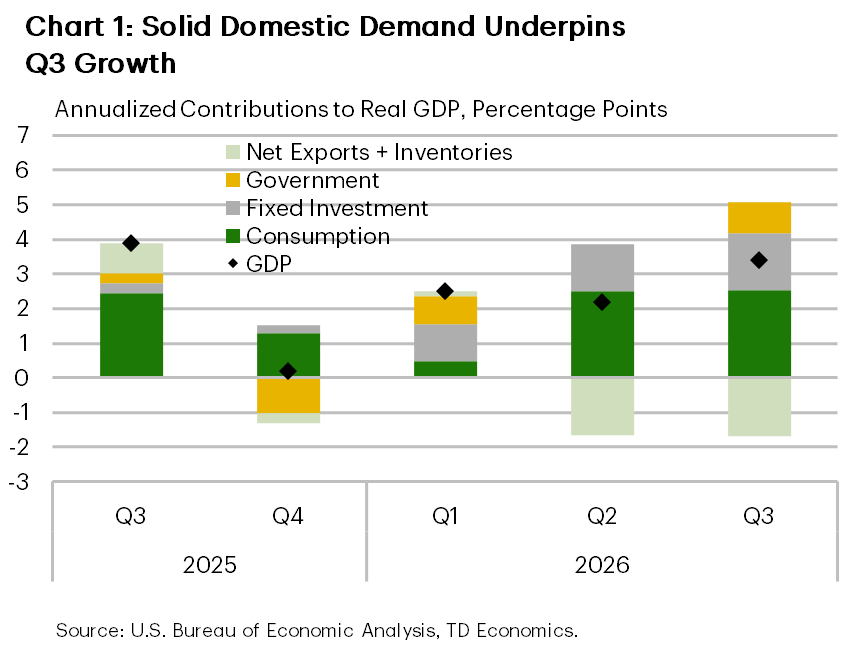
The U.S. economy seemingly shook off headwinds from rising interest rates and elevated oil prices through the third quarter, posting its fastest rate of expansion in a year (Chart 1). Looking under the hood, all the strength was sustained by domestic spending. The consumer remained a solid anchor – accounting for three-quarters of the gain in real GDP – while business investment expanded at its fastest pace since 2011(outside of the pandemic). Federal spending also chipped in, amid a sharp increase in both defense and non-defense expenditures.
Bigger picture, the central question remains how much of the growth reflects durable private demand versus concentrated investment in technology infrastructure. For Q3, roughly half of the gain in non-residential investment appears to be directly tied to AI. But there are also many indirect effects, including the buildout of power and electricity infrastructure, and the spillovers into other areas of investment like construction and industrial equipment. Nor does it account for the wealth effects that have undoubtedly contributed to some of the strength in consumer spending over the last six months. Suffice to say, the tentacles of the AI buildout are far reaching.
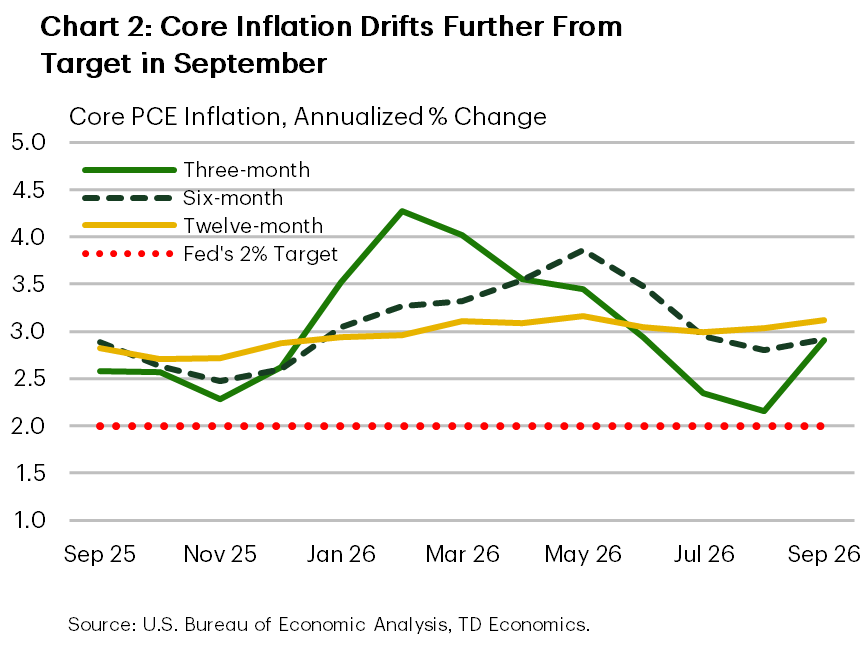
While the AI investment boom may be adding to the economy’s speed limit, it’s also contributing to inflationary pressures. Core PCE inflation was hot in September, with the 3,6-, and 12-month rates of change moving further away from the Fed’s 2% inflation target (Chart 2). Against this backdrop, further policy tightening will likely be required to return price stability. Exactly how much more remains to be seen. Should inflation trends loosely follow our forecast, and start to bend towards 2% by year-end, the Fed may be able to get away with only hiking one more time before calling it quits. However, more persistent price pressures will force policymakers to do more.
Looking ahead, next week’s employment report will offer a fresh test of whether the economy’s strong growth is translating into firmer hiring. Resilient job gains and wage growth would reinforce the case for further tightening, while a softer report would give the Fed more reason to proceed cautiously. Meanwhile, Tuesday’s midterm elections will determine the balance of power in Congress, helping to shape the fiscal outlook over the next two years.
Thomas Feltmate, Director & Senior Economist | 416-944-5730
This Financial News report is provided by TD Economics. It is for informational and educational purposes only as of the date of writing and may not be appropriate for other purposes. The views and opinions expressed may change at any time based on market or other conditions and may not come to pass. This material is not intended to be relied upon as investment advice or recommendations, does not constitute a solicitation to buy or sell securities and should not be considered specific legal, investment or tax advice. The report does not provide material information about the business and affairs of TD Bank Group and the members of TD Economics are not spokespersons for TD Bank Group with respect to its business and affairs. The information contained in this financial news report has been drawn from sources believed to be reliable but is not guaranteed to be accurate or complete. This report contains economic analysis and views, including about future economic and financial markets performance. These are based on certain assumptions and other factors and are subject to inherent risks and uncertainties. The actual outcome may be materially different. The Toronto-Dominion Bank and its affiliates and related entities that comprise the TD Bank Group are not liable for any errors or omissions in the information, analysis or views contained in this report, or for any loss or damage suffered. Do you have any questions about your finances? As financial advisors in Cornelius NC, Naples FL, and Moultonborough NH we are happy to help.
To see more news reports, click here.