
FINANCIAL NEWS HIGHLIGHTS OF THE WEEK
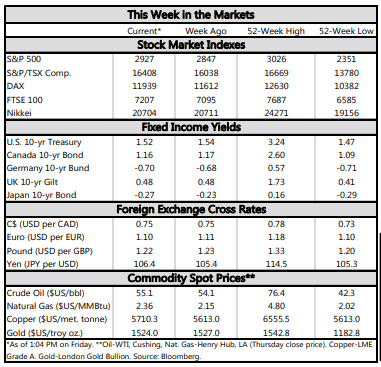
- US-China trade tensions spiked last Friday as both countries announced more protectionist measures against each other, but later eased this week. Equity markets swept the escalation under the rug, making a full recovery on the week.
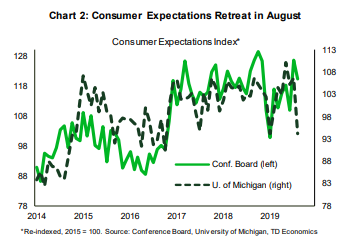
- Second-quarter U.S. GDP growth was little changed in a second reading, but consumption was revised up to an even better 4.7% annualized. Real spending was up 0.4% m/m in July, making for a solid start to third-quarter consumption.
- A cloud of uncertainty continues to weigh on the global economic outlook. The odds of a no-deal Brexit have increased following a planned shutdown of the UK’s Parliament from September 9th to mid-October. Meanwhile, parties are scrambling in Italy to form a new government, but the potential new coalition government stands on shaky footing.


Uncertainty Still Name of The Game

Equity markets shrugged off last Friday’s escalation, making a slow but full recovery on the week. Yet, there are strong indications that the trade conflict is a long way from being resolved. China clarified this week that products listed more than once in its three retaliatory rounds would in fact face a cumulative tariff rate. This would bring the tariff rate to 30% or higher for some imported U.S. products, including some autos and parts. On the other hand, the U.S. is still pushing ahead with an increase in the tariff rate from 10% to 15% that will affect $125bn in goods starting this Sunday. Altogether, these steps may jeopardize progress in talks scheduled for September.
A veil of uncertainty continues to weigh on the broader global economic outlook. In Latin America, the Argentine peso severely weakened as the country remains in economic crisis and on the brink of default. Meanwhile, across the pond, the UK’s parliament is set to be suspended for a few weeks at the request of PM Johnson in an effort to make an unimpeded final push for Brexit before the October 31st deadline. Next week will likely prove to be a tumultuous Parliamentary session that could see a vote of no-confidence put forward by the opposition Labour leader, and an election call possible before the week ends. A snap election could delay Brexit further. Meanwhile in Italy, two parties are attempting to form a new coalition after the Northern League pulled out of the ruling coalition government. A prospective new alliance between an anti-establishment and a center-left party appears to stand on shaky ground. Moreover, opinion polls indicate that the the Northern League remains the most popular party, so the tide could again turn quickly. It’s clear to see that uncertainty is still the name of the game.
Admir Kolaj, Economist | 416-944-6318
This report is provided by TD Economics. It is for informational and educational purposes only as of the date of writing, and may not be appropriate for other purposes. The views and opinions expressed may change at any time based on market or other conditions and may not come to pass. This material is not intended to be relied upon as investment advice or recommendations, does not constitute a solicitation to buy or sell securities and should not be considered specific legal, investment or tax advice. The report does not provide material information about the business and affairs of TD Bank Group and the members of TD Economics are not spokespersons for TD Bank Group with respect to its business and affairs. The information contained in this report has been drawn from sources believed to be reliable, but is not guaranteed to be accurate or complete. This report contains economic analysis and views, including about future economic and financial markets performance. These are based on certain assumptions and other factors, and are subject to inherent risks and uncertainties. The actual outcome may be materially different. The Toronto-Dominion Bank and its affiliates and related entities that comprise the TD Bank Group are not liable for any errors or omissions in the information, analysis or views contained in this report, or for any loss or damage suffered.