
FINANCIAL NEWS HIGHLIGHTS OF THE WEEK
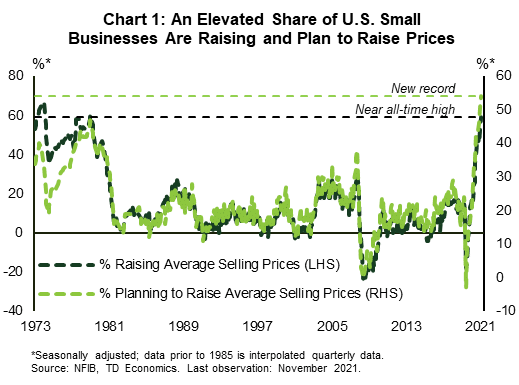
- Evidence of accelerating price pressures continued to trickle in this week. Producer prices accelerated to 9.6% year-on-year in November. This was accompanied by an elevated share of small businesses raising prices (+6 points to 59%).
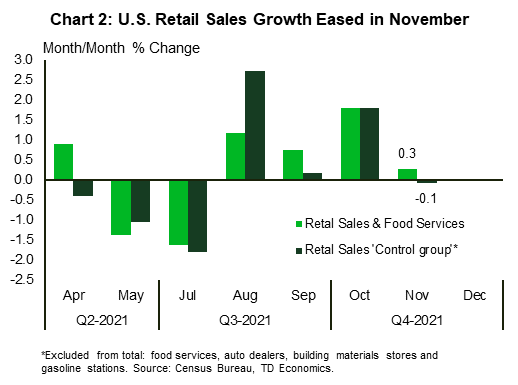
- After a strong gain of 1.8% in October, U.S. retail sales growth slowed to 0.3% (month-to-month) in November. Excluding the more volatile categories, sales in the “control group” fell 0.1% on the month.
- The Fed left the policy rate unchanged at this week’s FOMC meeting, but accelerated the taper of its Quantitative Easing (QE) program. This puts QE on track to end by March of next year, opening the door for rates to lift off soon after.
Slaying the Inflation Dragon
Inflation remained the focus of financial news markets this week, with economic data providing continued evidence of accelerating price pressures. Producer prices picked up steam, rising to 9.6% year-on-year in November from 8.8% in the month prior. The acceleration indicates broad-based price pressures throughout the supply chain. Small businesses are also cranking up the pressure. The National Federation of Independent Businesses optimism survey showed that in November, 59% of businesses had raised average selling prices and another 54% plan to raise them further in the months ahead. The former metric is near its all-time high set in the 1970s and the latter is at a new record (Chart 1).
Inflationary pressures also featured prominently in the retail sales report. Sales rose 0.3% in November, below the consensus forecast for a 0.8% print (Chart 2). A strong 1.7% showing in sales at gasoline stations, which reflects hefty energy price gains, helped drive up the headline. Excluding the more volatile categories (including gasoline), sales in the “control group,” used to estimate personal consumption expenditures (PCE), were down 0.1% on the month. The soft November print can be partially explained by some pull-forward in activity, with consumers starting their holiday shopping early given expected shortages and delays. Less generous holiday discounts relative to what consumers may have been accustomed to are also likely to have played a role in last month’s slow-down. A further moderation in activity is likely in December, given the added hurdle of a worsening epidemiological situation.
New COVID-19 infections have risen across much of the country and hospitalizations have followed suit. The infections trend is likely to worsen further with the spread of the much more transmissible Omicron variant, which has been detected in most U.S. states (see here). This is expected to weigh on consumer and tourism-related activities.
The Fed is well aware of the above two competing forces – rising inflationary pressures and a worsening public health situation. Economic projections from this week’s FOMC meeting show that most committee members expect the setback from the latest infection wave to prove short-lived. The median forecast calls for the unemployment rate to fall further, reaching 3.5% by the end of 2022. Another potential obstacle to growth, the country’s debt ceiling, was neutralized with the swipe of the pen on Thursday, with President Biden signing a $2.5T ceiling increase into law.
Continued progress toward maximum employment will allow the Fed to focus its efforts on slaying the inflation dragon. It is already moving in that direction. The Fed left the policy rate unchanged at this week’s FOMC meeting, but accelerated the taper of its Quantitative Easing (QE) program. The Fed will reduce the monthly pace of purchases of Treasuries securities by $20 billion and agency mortgage-back securities by $10 billion. This puts QE on track to end by March of next year, opening the window for rates to lift off soon after. This is in line with our expectations. In our updated forecast published earlier this week, we pulled forward our call for the first rate hike to the second quarter of next year, with two more hikes to follow later in the year. This will still leave monetary policy in an accommodative stance, but should help to stem the inflationary tide.
Admir Kolaj, Economist | 416-944-6318
This Financial News report is provided by TD Economics. It is for informational and educational purposes only as of the date of writing, and may not be appropriate for other purposes. The views and opinions expressed may change at any time based on market or other conditions and may not come to pass. This material is not intended to be relied upon as investment advice or recommendations, does not constitute a solicitation to buy or sell securities and should not be considered specific legal, investment or tax advice. The report does not provide material information about the business and affairs of TD Bank Group and the members of TD Economics are not spokespersons for TD Bank Group with respect to its business and affairs. The information contained in this report has been drawn from sources believed to be reliable, but is not guaranteed to be accurate or complete. This report contains economic analysis and views, including about future economic and financial markets performance. These are based on certain assumptions and other factors, and are subject to inherent risks and uncertainties. The actual outcome may be materially different. The Toronto-Dominion Bank and its affiliates and related entities that comprise the TD Bank Group are not liable for any errors or omissions in the information, analysis or views contained in this report, or for any loss or damage suffered.