
FINANCIAL NEWS HIGHLIGHTS OF THE WEEK
- It was another volatile week across global financial markets as the recent surge in commodity prices stoked fears of an inflationary spiral. Sentiment improved through the latter half of the week, allowing global equities to pare losses.
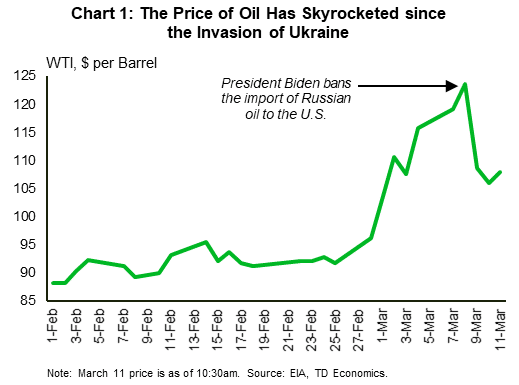
- Oil remained a focal point, with WTI briefly touching $128 per-barrel on Tuesday following President Biden’s announcement to ban the import of Russian oil. Gains were later reversed on the hopes of increased OPEC production.
- February CPI data showed a further acceleration in consumer prices, with both headline (+7.9% y/y/) and core (+6.4% y/y) inflation rising to new 40-year highs. With price pressures likely to continue to mount over the coming months, the FOMC is certain to raise rates next week.
U.S. -Looking Through the Turmoil, Ready for Lift-off
Despite Fed officials entering a ‘quiet week’ ahead of next Thursday’s FOMC meeting, it was anything but across global financial markets in financial news. New economic sanctions and fears of a prolonged Ukraine-Russia conflict have pushed commodity prices significantly higher in recent weeks, stoking fears of an inflationary spiral that could trigger a recession across Europe. The risk-off sentiment abated through the latter half of this week, allowing global equites to pare losses. At the time of writing, the S&P 500 was still lower by about 1.5%. Yields rose through much of the week, as intensifying price pressures pushed the US 10-year higher by 25 basis points to just over 2%.
Across the commodity space, oil remained a focal point. On Tuesday, both WTI and Brent briefly touched levels not seen since 2008, hitting $128 and $133 per-barrel, respectively. The sharp gains followed President Biden’s announcement that the U.S. will immediately ban imports of Russian oil. The UK made a similar commitment, agreeing to phase-out imports of Russian oil by year-end. Gains, however, were reversed from their intraweek highs on hopes that OPEC members would boost production to help make up for some of the shortfall. At the time of writing, WTI is currently down 7% on the week, trading at $108 per-barrel (Chart 1).
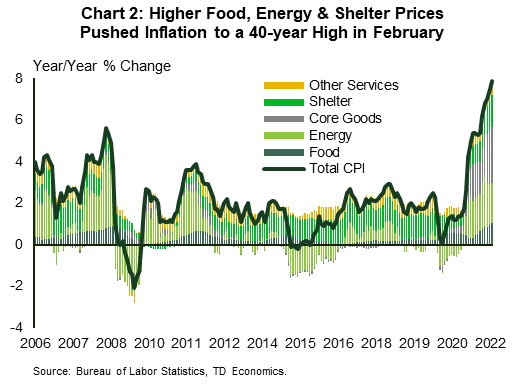
Inflation also remained a key theme for the week, as Thursday’s release of February CPI data showed a further acceleration in consumer prices. Headline CPI rose 0.8% month-on-month (m/m), which drove the year-on-year measure to 7.9% (Chart 2). Core inflation was up a softer 0.5% m/m – a slight deceleration from January – though still enough to push the annual reading to a new 40-year high of 6.4%. Higher fuel prices (6.4% m/m), food (1.0% m/m) and shelter costs (0.5% m/m) were the biggest contributors to February’s price gain. Also noteworthy was the modest cooling in used vehicle prices (-0.2% m/m), which came after four consecutive months of strong gains. New vehicle prices were still higher in February, though even here we have seen a meaningful deceleration in price growth in recent months, suggesting consumer’s may be nearing a ceiling of what they’re willing to spend for a new vehicle.
Unfortunately, inflationary pressures are likely to continue to move higher over the coming months, as the recent surge in commodity prices will continue to filter through to higher prices both at the pump and grocery stores. Even if gasoline prices hung at today’s level of $4.32 per-gallon for the rest of the month, that alone would lift headline CPI for March by an additional 0.9 percentage points.
The pinch on consumer’s wallets could lead to slightly weaker discretionary spending over the near-term, but this is unlikely to dissuade Fed officials from raising rates at next week’s meeting in further financial news. Inflationary pressures are running too hot, and the labor market has become as tight as it has ever been. Failing to move on rates runs the risk of the Fed falling even further behind the curve, which would erode its credibility and jeopardize the economic recovery. Expect the FOMC to acknowledge the recent tightening in financial market conditions, but maintain its hawkish tone, setting the stage for what will be a series of rate hikes over the remainder of the year.
Thomas Feltmate, Senior Economist | 416-944-5730
This Financial News report is provided by TD Economics. It is for informational and educational purposes only as of the date of writing and may not be appropriate for other purposes. The views and opinions expressed may change at any time based on market or other conditions and may not come to pass. This material is not intended to be relied upon as investment advice or recommendations, does not constitute a solicitation to buy or sell securities and should not be considered specific legal, investment or tax advice. The report does not provide material information about the business and affairs of TD Bank Group and the members of TD Economics are not spokespersons for TD Bank Group with respect to its business and affairs. The information contained in this report has been drawn from sources believed to be reliable but is not guaranteed to be accurate or complete. This report contains economic analysis and views, including about future economic and financial markets performance. These are based on certain assumptions and other factors and are subject to inherent risks and uncertainties. The actual outcome may be materially different. The Toronto-Dominion Bank and its affiliates and related entities that comprise the TD Bank Group are not liable for any errors or omissions in the information, analysis or views contained in this report, or for any loss or damage suffered.