
Financial News Highlights
- The risk of a government shutdown has returned as Congress has one week left before the continuing resolution passed on September 30th expires in governmental and financial news.
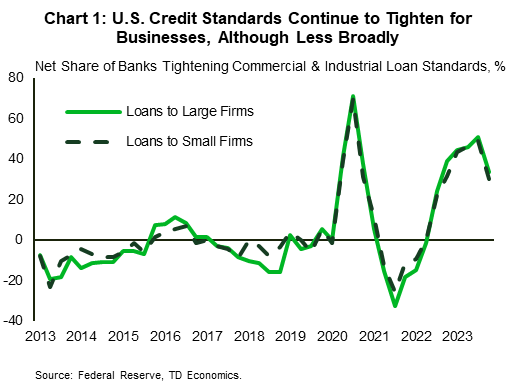
- The Federal Reserve’s Senior Loan Officer Opinion Survey showed that banks continued to tighten credit standards in the third quarter, as credit demand weakened further.
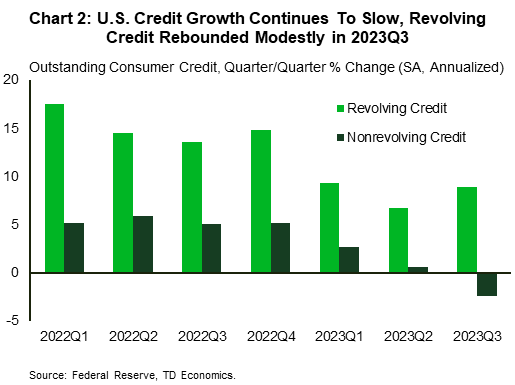
- Consumer credit growth eased in the third quarter as an acceleration in revolving credit growth (i.e. credit cards) was offset by a contraction in nonrevolving credit (i.e. student loans).
Government Shutdown Risk Redux
 After last week’s busy slate markets took a breather to digest last week’s Federal Reserve policy decision and prepare for the risk of another potential government shutdown next Friday in financial news. On the data front, the Federal Reserve Senior Loan Officer Opinion Survey (SLOOS) and consumer credit report both showed credit conditions remained tight and demand continues to wane.
Monday’s release of the SLOOS showed that banks continued to tighten credit standards across loan categories in the third quarter and report weaker business and consumer demand for loans (see here). Although this came as little surprise considering Treasury yields rose by roughly 100 basis-points in Q3, the share of banks reporting tighter standards for commercial and industrial loans actually declined relative to the second quarter (Chart 1). This also held true for consumer credit cards and auto loans, although personal and mortgage loans each saw broader tightening relative to the second quarter. Despite the modest narrowing of credit tightening in the third quarter, the Federal Reserve’s continued signaling of rates staying higher for longer means a material loosening of credit standards likely remains a way off.
Easing consumer demand for loans was also evident in the Federal Reserve’s consumer credit data release on Tuesday which showed outstanding credit growth slowed notably relative to the second quarter. Outstanding revolving credit loans, which includes credit cards, saw accelerating growth in the third quarter of 8.6% while non-revolving credit growth, which includes student loans, declined by 2.4% (Chart 2). Under the weight of higher prices many consumers are increasingly relying on revolving credit to support spending, particularly as the moratorium on student loan repayment ends. Next week’s retail sales data will show whether the past six months of real sales growth, aided by consumer credit, continued into October despite the growing headwinds facing consumers.
 In addition, updated CPI data out next week is expected to show continued easing in aggregate price pressures, supported by cooling energy prices. While this would undoubtedly be positive news, core inflation, which excludes food and energy prices, is expected to persist well above the Federal Reserve’s 2% target. A majority of FOMC members have noted that their current pause is conditional on sustained disinflation progress, with Chair Powell stating on Thursday that “if it becomes appropriate to tighten policy further, we will not hesitate to do so”.
Rounding out the coming week is the return of the risk of a potential government shutdown (see here) as the continuing resolution passed on September 30th expires on Friday, November 17th. Of the twelve appropriation bills that need to be passed to fund the federal government, the House has passed seven and the Senate has passed three with no consolidated bill managing to pass both chambers of Congress. This means that another continuing resolution may be used as a stopgap once again, but markets are likely to become increasingly apprehensive as Friday’s deadline approaches.
Andrew Foran, Economist | 416-350-8927
This Financial News report is provided by TD Economics. It is for informational and educational purposes only as of the date of writing and may not be appropriate for other purposes. The views and opinions expressed may change at any time based on market or other conditions and may not come to pass. This material is not intended to be relied upon as investment advice or recommendations, does not constitute a solicitation to buy or sell securities and should not be considered specific legal, investment or tax advice. The report does not provide material information about the business and affairs of TD Bank Group and the members of TD Economics are not spokespersons for TD Bank Group with respect to its business and affairs. The information contained in this financial news report has been drawn from sources believed to be reliable but is not guaranteed to be accurate or complete. This report contains economic analysis and views, including about future economic and financial markets performance. These are based on certain assumptions and other factors and are subject to inherent risks and uncertainties. The actual outcome may be materially different. The Toronto-Dominion Bank and its affiliates and related entities that comprise the TD Bank Group are not liable for any errors or omissions in the information, analysis or views contained in this report, or for any loss or damage suffered. Do you have any questions about your finances? As financial advisors in Cornelius NC, Naples FL, and Moultonborough NH we are happy to help.
To see more news reports, click here.