
Financial News Highlights
- Tech stocks led the week’s sell-off, but markets are still fully pricing in a December Fed hike.
- Underlying retail sales held up in October, even as headline growth slowed. Falling permits cast doubt on the rebound in housing starts.
- The Fed minutes showed that nearly all officials expected more hikes. The question is how fast to move.
Tech Stocks Slide, but December Hike Bets Hold
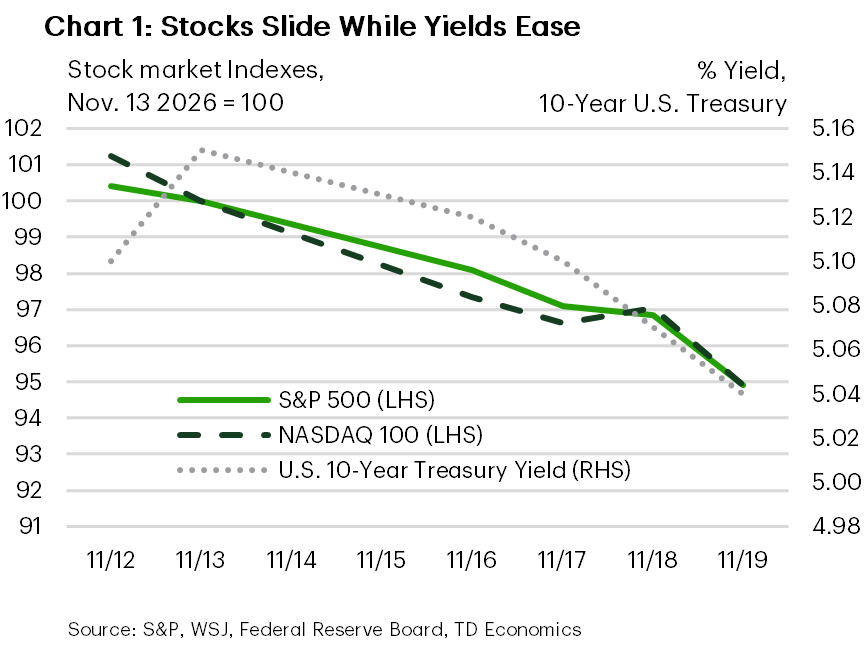
Investors cooled on tech stocks this week, but they didn’t budge much on the Fed. Anthropic’s market debut failed to rekindle enthusiasm for AI stocks on Thursday, and the tech-heavy Nasdaq fell more sharply than the S&P 500, which extended its losing streak. Long-term Treasury yields dipped alongside stocks, but markets still overwhelmingly priced in a quarter-point hike in December (Chart 1).
The October FOMC minutes help explain why a December hike looks to be a lock. The two votes for an immediate quarter-point hike at the prior meeting were already public. The minutes went further than the press conference: many officials wanted time to see how September’s hike was working, but nearly all expected to raise rates again under their baseline outlooks. A couple were open to a bigger move in December if inflation came in hotter than expected.
This week’s Fed speakers put that difference in plain terms. Governor Christopher Waller favored a half-point hike in December unless the Fed clearly signals another move in January, while New York Fed President John Williams saw no need for dramatic action. Vice Chair Philip Jefferson pointed to another reason not to count on quick inflation relief: the AI buildout is adding to demand and inflation now, while any relief from higher productivity would come later. A quarter-point hike still looks like the better fit for a committee that largely agrees on direction but not on pace.
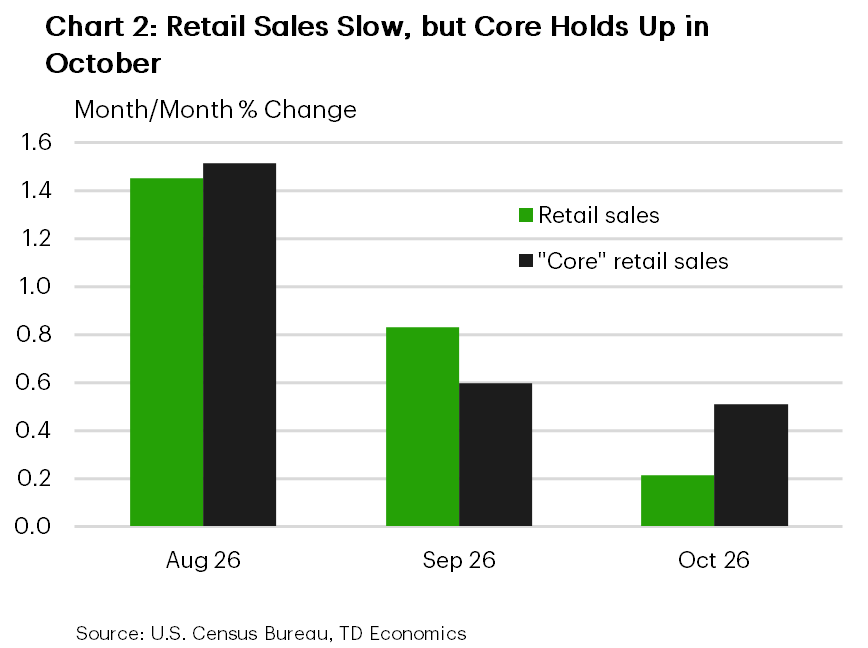
One clue to how quickly the Fed might need to move is how well spending is holding up. October’s retail report gave a mixed answer. Overall sales edged up before adjusting for inflation and slipped afterward. Weaker auto sales dragged on the headline, while higher pump prices boosted gas station receipts. The control group, which excludes autos, gasoline, building materials and food services and helps estimate goods spending, matched September’s solid gain, with online retailers among the stronger categories. Holiday spending looks to be on firmer footing than the headline alone suggests (Chart 2).
With goods spending holding up and the Fed still leaning toward more hikes, homebuilders aren’t likely to get much relief from high borrowing costs soon. Housing starts bounced in October, led by multifamily construction, though single-family starts rose too. Permits fell in both segments, pointing to fewer projects ahead. That makes October look more like a bounce than the start of a lasting recovery.
Could next week’s data change the rate outlook? On Wednesday, the second estimate of third-quarter GDP will show whether the initial 3.4% annualized gain holds up and whether domestic demand was stronger or weaker than first reported. October’s Personal Income and Outlays report will give a fresher read on whether real consumer spending held up despite the dip in inflation-adjusted retail sales. For the Fed, core PCE inflation is the one to watch: a cooler reading would support a quarter-point hike in December, while a hotter one could put a larger move back in play.
Vikram Rai, Senior Economist | 416-923-1692
This Financial News report is provided by TD Economics. It is for informational and educational purposes only as of the date of writing and may not be appropriate for other purposes. The views and opinions expressed may change at any time based on market or other conditions and may not come to pass. This material is not intended to be relied upon as investment advice or recommendations, does not constitute a solicitation to buy or sell securities and should not be considered specific legal, investment or tax advice. The report does not provide material information about the business and affairs of TD Bank Group and the members of TD Economics are not spokespersons for TD Bank Group with respect to its business and affairs. The information contained in this financial news report has been drawn from sources believed to be reliable but is not guaranteed to be accurate or complete. This report contains economic analysis and views, including about future economic and financial markets performance. These are based on certain assumptions and other factors and are subject to inherent risks and uncertainties. The actual outcome may be materially different. The Toronto-Dominion Bank and its affiliates and related entities that comprise the TD Bank Group are not liable for any errors or omissions in the information, analysis or views contained in this report, or for any loss or damage suffered. Do you have any questions about your finances? As financial advisors in Cornelius NC, Naples FL, and Moultonborough NH we are happy to help.
To see more news reports, click here.