
Financial News Highlights
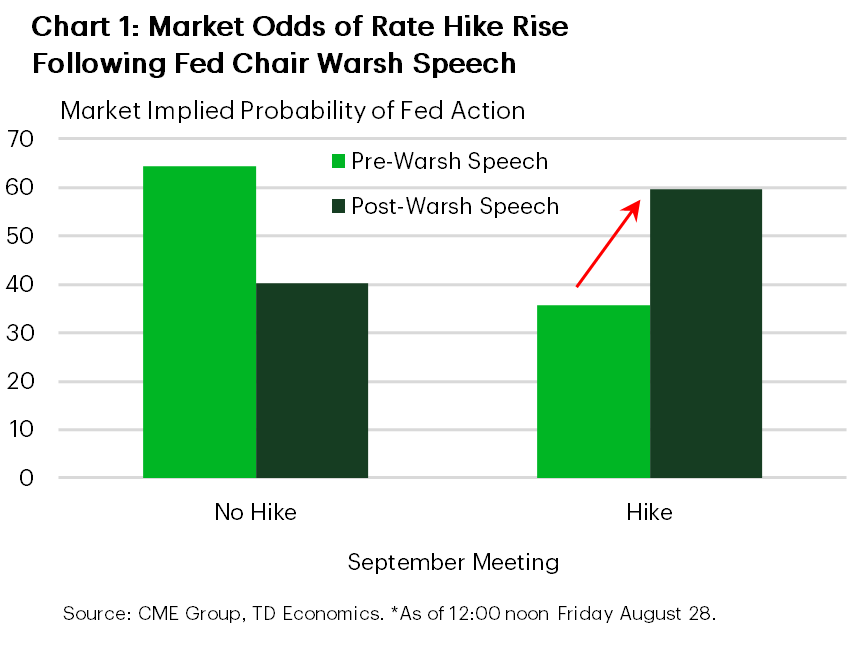
- In his Jackson Hole keynote, Fed Chair Kevin Warsh delivered a hawkish assessment, prompting market odds
to shift firmly toward a near-term rate hike. - The second estimate of Q2 GDP left headline growth unchanged at 1.5% annualized, but revised growth in real
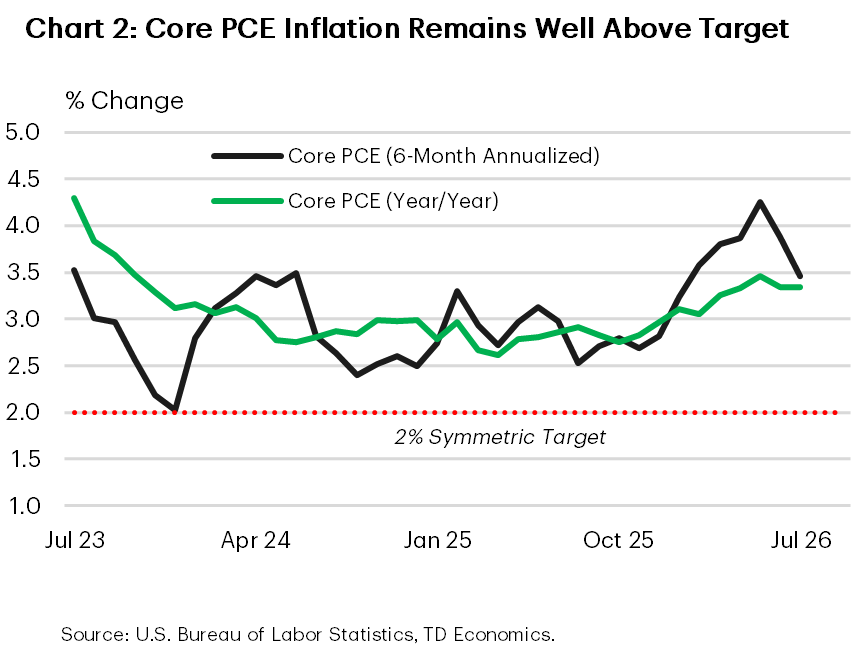
final sales to private domestic purchasers up moderately to a strong 4.2%. - July’s PCE report offered little evidence of renewed disinflation, with core inflation remaining well above the
Federal Reserve’s 2% target.
A Hawkish Assessment, Still No Forward Guidance
U.S. markets spent the week balancing resilient demand against persistent inflation and renewed trade frictions. The main event, however, was Fed Chair Warsh’s Friday keynote at Jackson Hole. While offering little meeting-specific guidance, he delivered a hawkish assessment that underlying inflation remains too high, pushing short-term Treasury yields and the trade-weighted U.S. dollar higher, while equities also posted modest gains.
Warsh outlined a principles-based approach to monetary policy and argued that forward guidance had “overstayed its welcome.” The Fed, in his view, should explain its objectives and framework without pre-committing to a rate path or encouraging investors to trade on policymakers’ signals. Structural changes, including artificial intelligence and greater competition for global savings, also require the Fed to reconsider assumptions formed during the previous low-rate era.
On the outlook, Warsh described the labor market as consistent with full employment but inflation as more concerning. Recent readings had not convinced him that underlying trends had improved meaningfully, and he was “hard pressed to describe broad financial conditions as restrictive.” While stopping short of explicitly endorsing a near-term hike, he warned the Fed has “work to do” if inflation does not move sufficiently toward target. He was committing to “a discipline, not to a decision.” Market pricing following the speech shifted firmly toward a near-term rate hike (Chart 1).
Other releases continued to point to a resilient economy. The second estimate of Q2 GDP left growth unchanged at 1.5% annualized, but stronger details pointed to solid underlying demand. Real final sales to private domestic purchasers were revised up moderately to 4.2%. On payrolls, a preliminary benchmark revision placed the March 2026 payroll level 79,000 below the current estimate, a modest adjustment that leaves the labour-market picture relatively intact.
July’s income and spending report showed decent consumer momentum despite a soft month. Real spending was unchanged in July, but the three-month annualized trend is running at a healthy 3.3%, consistent with consumer spending of 2.5% in Q3. More importantly for the Fed, core PCE inflation remained well above target, offering little evidence of renewed disinflation (Chart 2).
Warsh’s task is complicated by forces outside the Fed. Treasury’s expanded purchases of longer-dated debt could lower borrowing costs working against monetary restraint. Trade tensions pose another inflation risk. The U.S. imposed 50% tariffs on $20 billion of Canadian goods, including USMCA-compliant products, while Canada announced matching countermeasures effective September 8. The direct effect should remain manageable at the current scale, but further escalation remains a risk.
The bottom line is that Warsh provided little guidance on timing but a clearer, hawkish policy bias. With growth resilient, a lot is riding on the August CPI report to show progress on underlying inflation and keep the Fed on the sidelines.
This Financial News report is provided by TD Economics. It is for informational and educational purposes only as of the date of writing and may not be appropriate for other purposes. The views and opinions expressed may change at any time based on market or other conditions and may not come to pass. This material is not intended to be relied upon as investment advice or recommendations, does not constitute a solicitation to buy or sell securities and should not be considered specific legal, investment or tax advice. The report does not provide material information about the business and affairs of TD Bank Group and the members of TD Economics are not spokespersons for TD Bank Group with respect to its business and affairs. The information contained in this financial news report has been drawn from sources believed to be reliable but is not guaranteed to be accurate or complete. This report contains economic analysis and views, including about future economic and financial markets performance. These are based on certain assumptions and other factors and are subject to inherent risks and uncertainties. The actual outcome may be materially different. The Toronto-Dominion Bank and its affiliates and related entities that comprise the TD Bank Group are not liable for any errors or omissions in the information, analysis or views contained in this report, or for any loss or damage suffered. Do you have any questions about your finances? As financial advisors in Cornelius NC, Naples FL, and Moultonborough NH we are happy to help.
To see more news reports, click here.