
Financial News Highlights
- Persistent inflation and more momentum than expected in the economy led the Federal Reserve to raise interest rates this week.
- In our view, another rate hike appears likely, though the expected easing in inflationary pressures through H1-2027 could lead to a policy reversal in H2-2027.
- AI-related volatility and higher oil prices underscore the same tension—growth remains durable, but the forces sustaining it are also complicating the path back to 2% inflation.
U.S. – AI Highs, Oil Shocks and Higher Rates
Markets confronted a less comfortable version of the soft-landing story this week. Fresh AI headlines prompted investors to reassess when enormous capital commitments will translate into profits, while higher oil prices revived concerns about inflation and household purchasing power. Treasury yields rose as investors reconsidered the path of policy rates and the compensation required to hold longer-dated bonds. Strong investment and consumer spending are keeping financial conditions relatively loose and inflation firmer than policymakers would prefer.
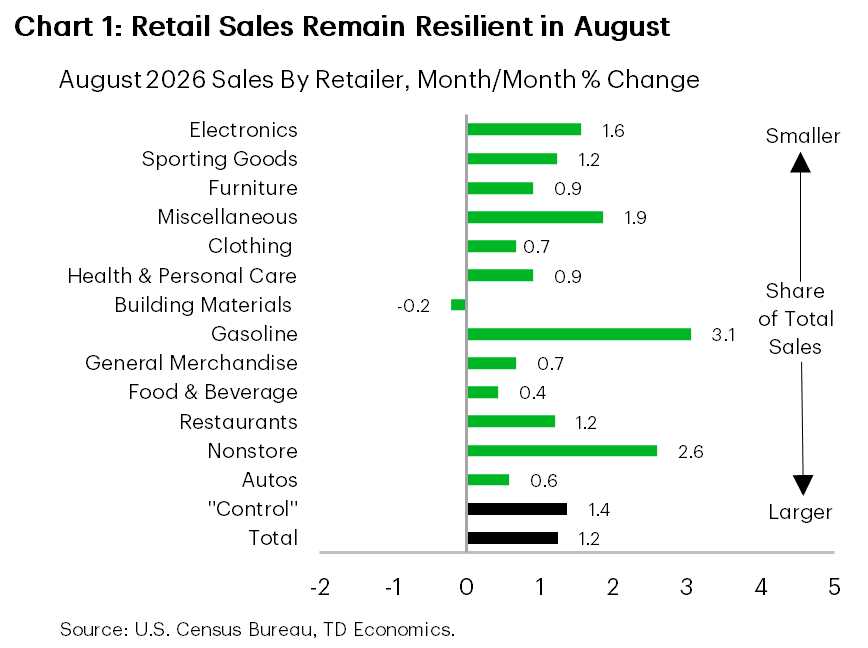
Wednesday’s retail-sales surprise reinforced that notion. August sales rose 1.2% month-on-month, well ahead of expectations, with broad-based gains beyond gasoline and autos (Chart 1). Inflation-adjusted spending also advanced solidly, lifting our tracking for third-quarter consumption and near-term GDP growth. Housing starts offered a softer counterpoint, falling 2.6% as weaker multifamily construction outweighed stronger single-family building, while lower permits pointed to further moderation. As one of the economy’s more interest-rate-sensitive sectors, housing is being hampered by higher borrowing costs. Yet with financial conditions still supporting investment and consumer demand, this weakness remains concentrated. The economy’s resilience makes a rapid return to lower rates less likely, as strong spending keeps tighter policy necessary to restrain inflation.
The FOMC expressed this logic in Wednesday’s decision. In addition to raising its policy rate, the Federal Reserve signaled that the current stance is not sufficiently restrictive and left the door open to further tightening. Chair Kevin Warsh was unusually clear: rates had to rise because inflation has remained too high for too long, financial conditions are not clearly restraining demand, and the persistent oil shock could spread into broader price setting. The University of Michigan consumer sentiment survey reinforced that assessment, with year-ahead inflation expectations jumping to 4.6% from 4.0% and long-run expectations edging up to 3.4%.
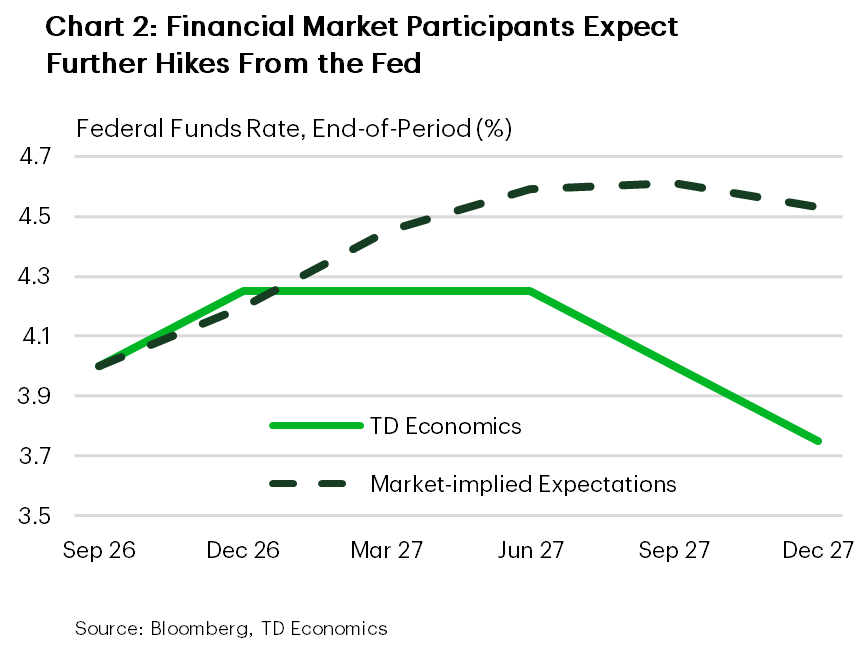
Our latest Quarterly Economic Forecast reaches a similar conclusion. We now expect another rate hike this year and a later start to easing—a meaningful shift from our previous view that the Fed could remain on hold as inflation subsided (Chart 2). Resilient consumer demand and AI-led investment are extending the expansion, but also slowing the final stage of disinflation.
Next week’s lighter data calendar should show whether stronger growth is broadening beyond consumers and AI investment. Business surveys, housing data, durable-goods orders and a raft of Fed speeches will provide useful signals, but the conclusion is unlikely to hinge on any single release. Resilience is both the economy’s greatest strength and its main policy complication: growth is holding up, but delaying the rate relief households and businesses had expected.
Vikram Rai, Senior Economist | 416-923-1692
This Financial News report is provided by TD Economics. It is for informational and educational purposes only as of the date of writing and may not be appropriate for other purposes. The views and opinions expressed may change at any time based on market or other conditions and may not come to pass. This material is not intended to be relied upon as investment advice or recommendations, does not constitute a solicitation to buy or sell securities and should not be considered specific legal, investment or tax advice. The report does not provide material information about the business and affairs of TD Bank Group and the members of TD Economics are not spokespersons for TD Bank Group with respect to its business and affairs. The information contained in this financial news report has been drawn from sources believed to be reliable but is not guaranteed to be accurate or complete. This report contains economic analysis and views, including about future economic and financial markets performance. These are based on certain assumptions and other factors and are subject to inherent risks and uncertainties. The actual outcome may be materially different. The Toronto-Dominion Bank and its affiliates and related entities that comprise the TD Bank Group are not liable for any errors or omissions in the information, analysis or views contained in this report, or for any loss or damage suffered. Do you have any questions about your finances? As financial advisors in Cornelius NC, Naples FL, and Moultonborough NH we are happy to help.
To see more news reports, click here.