
HIGHLIGHTS OF THE WEEK
- The U.S. economy grew a robust 2.9% in 2018, the best performance since 2015, but growth moderated at the end of the year and at the start of 2019. The government shutdown and soft consumer spending in December are expected to translate into near 1% growth this quarter.
- Extending the barrage of negative housing data, housing starts plunged by 11.2% (m/m) in December to 1.08 million (annualized).
- Manufacturing data remained soft. The U.S. ISM manufacturing index declined in February, and manufacturing contraction in Europe and Asia broadened further. Soft global activity reinforces the Fed’s patient stance.


Strong 2018 Finish But a Soft Start to 2019
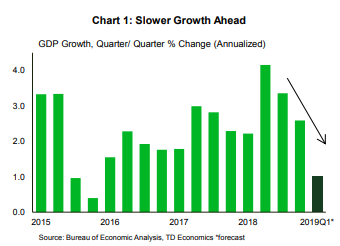
The fourth quarter GDP report painted a picture of solid but moderating growth. For the year as a whole, the economy expanded by a robust 2.9% in 2018. However, the headline conceals the fact that growth moderated as the year progressed, slowing to 2.6% (annualized) in Q4 from the 3.4% and 4.2% pace seen in Q3 and Q2, respectively. Looking at the individual components, consumer spending moderated to 2.8% in Q4 from 3.5% in Q3. Business investment surprised to the upside, with growth accelerating to 6.2% from a 2.5% pace in the previous quarter. However, trade and residential investment were a drag on growth both in Q4 and for the year as a whole.
A solid end to 2018, but momentum has clearly waned at the start of this year. Consumer spending data for December confirmed that the weak retail print was not a fluke, as the negative mood led consumers to hold on tight to their wallets. In what’s become a recurring theme, first quarter growth will be bleak. The government shutdown and soft consumer spending translate to growth slowing to 1% in Q1 (Chart 1). However, as in prior years, the slowdown should prove temporary, with output forecast to rebound to an above 2% pace in the second quarter.

Less hopeful is the underwhelming manufacturing data from this morning that suggests that the global manufacturing rout is not easing. The U.S. ISM manufacturing index declined in February, falling to the lowest level in more than a year, but remaining firmly in expansionary territory. Trade and Brexit uncertainty are a bigger drag on business sentiment in the Euro Area, where a broadening contraction in manufacturing PMIs is underway. Ditto for Japanese, Chinese, and ASEAN manufacturers.
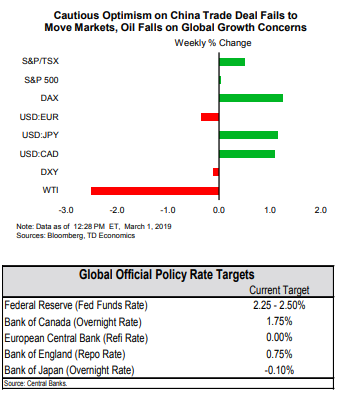
On a positive note, trade tensions with China appear to be easing somewhat. Substantial progress on a trade deal has been made and the scheduled March 1st increase in tariffs on imports from China has been suspended. However, the progress on talks may have come too little too late, and the tariff cloud may continue to cast a shadow on global economy for some time, reinforcing the Fed’s patient stance.
Leslie Preston, Senior Economist | 416-983-7053
This report is provided by TD Economics. It is for informational and educational purposes only as of the date of writing, and may not be appropriate for other purposes. The views and opinions expressed may change at any time based on market or other conditions and may not come to pass. This material is not intended to be relied upon as investment advice or recommendations, does not constitute a solicitation to buy or sell securities and should not be considered specific legal, investment or tax advice. The report does not provide material information about the business and affairs of TD Bank Group and the members of TD Economics are not spokespersons for TD Bank Group with respect to its business and affairs. The information contained in this report has been drawn from sources believed to be reliable, but is not guaranteed to be accurate or complete. This report contains economic analysis and views, including about future economic and financial markets performance. These are based on certain assumptions and other factors, and are subject to inherent risks and uncertainties. The actual outcome may be materially different. The Toronto-Dominion Bank and its affiliates and related entities that comprise the TD Bank Group are not liable for any errors or omissions in the information, analysis or views contained in this report, or for any loss or damage suffered.