
HIGHLIGHTS OF THE WEEK
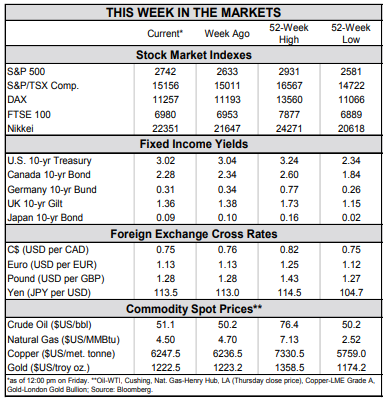
- FOMC minutes released this week suggested that flexible could be the new gradual for the Fed. While a rate hike for December may be in the cards, future moves are now more dependent on the incoming economic data.
- President Trump and Xi are set to meet-up at the G20 summit over the weekend. Stakes are high for an agreement to be reached. If not, higher tariffs are set to kick-in come January.
- While cracks are starting to show in the armor of the U.S. economic expansion, there’s still plenty that’s going well. Q3 GDP growth remained solid, consumer spending is strong, income gains are healthy and inflation is contained.

Yellow is the New Green?

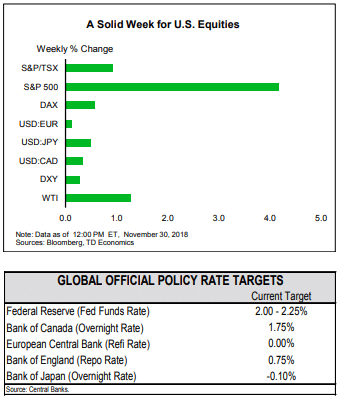
FOMC minutes suggest that a rate hike in December is all but a done deal, but the path thereafter is more uncertain. Indeed, Fed members emphasized the need to maintain flexibility in order to respond to changing economic data. A shift in tenor from possible overheating to slower-than-expected growth was also discernible in the details of the discussion. Trade tensions in particular were “cited as a factor that could slow economic growth more than expected.”
In that vein, the trade tug-of-war with China continues. The hope is that negotiations go well at the G20 meetings in Buenos Aires that kicked-off Friday. The stakes are high. President Trump signaled prior to the meeting that if the two countries failed to reach an agreement favorable to the U.S., additional tariff on virtually all U.S. imports from China would be forthcoming. Such a development would exacerbate the slowdown in global growth – another risk flagged by the Fed.

The good news is that consumers are showing little sign of fatigue. Consumer spending grew robustly in October, rising 0.4% and setting the stage for a strong showing in the final quarter of this year. Holiday spending may get a further lift as households spend the extra coin left in their wallets after filling up at the gas pumps. Revisions to third quarter GDP were similarly encouraging (Chart 2) with business and residential investment revised up.
Overall, the economic data flow out of the U.S. this week was relatively balanced. Unfortunately, the downside risks to the outlook are mounting. It became clearer this week that the Fed is paying more attention to these risks and the economy may not need as many rate hikes as they believed back in September. All said, yellow may become the new green for the still-global-growth-leading U.S. economy.
Shernette McLeod, Economist | 416-415-0413
This report is provided by TD Economics. It is for informational and educational purposes only as of the date of writing, and may not be appropriate for other purposes. The views and opinions expressed may change at any time based on market or other conditions and may not come to pass. This material is not intended to be relied upon as investment advice or recommendations, does not constitute a solicitation to buy or sell securities and should not be considered specific legal, investment or tax advice. The report does not provide material information about the business and affairs of TD Bank Group and the members of TD Economics are not spokespersons for TD Bank Group with respect to its business and affairs. The information contained in this report has been drawn from sources believed to be reliable, but is not guaranteed to be accurate or complete. This report contains economic analysis and views, including about future economic and financial markets performance. These are based on certain assumptions and other factors, and are subject to inherent risks and uncertainties. The actual outcome may be materially different. The Toronto-Dominion Bank and its affiliates and related entities that comprise the TD Bank Group are not liable for any errors or omissions in the information, analysis or views contained in this report, or for any loss or damage suffered.